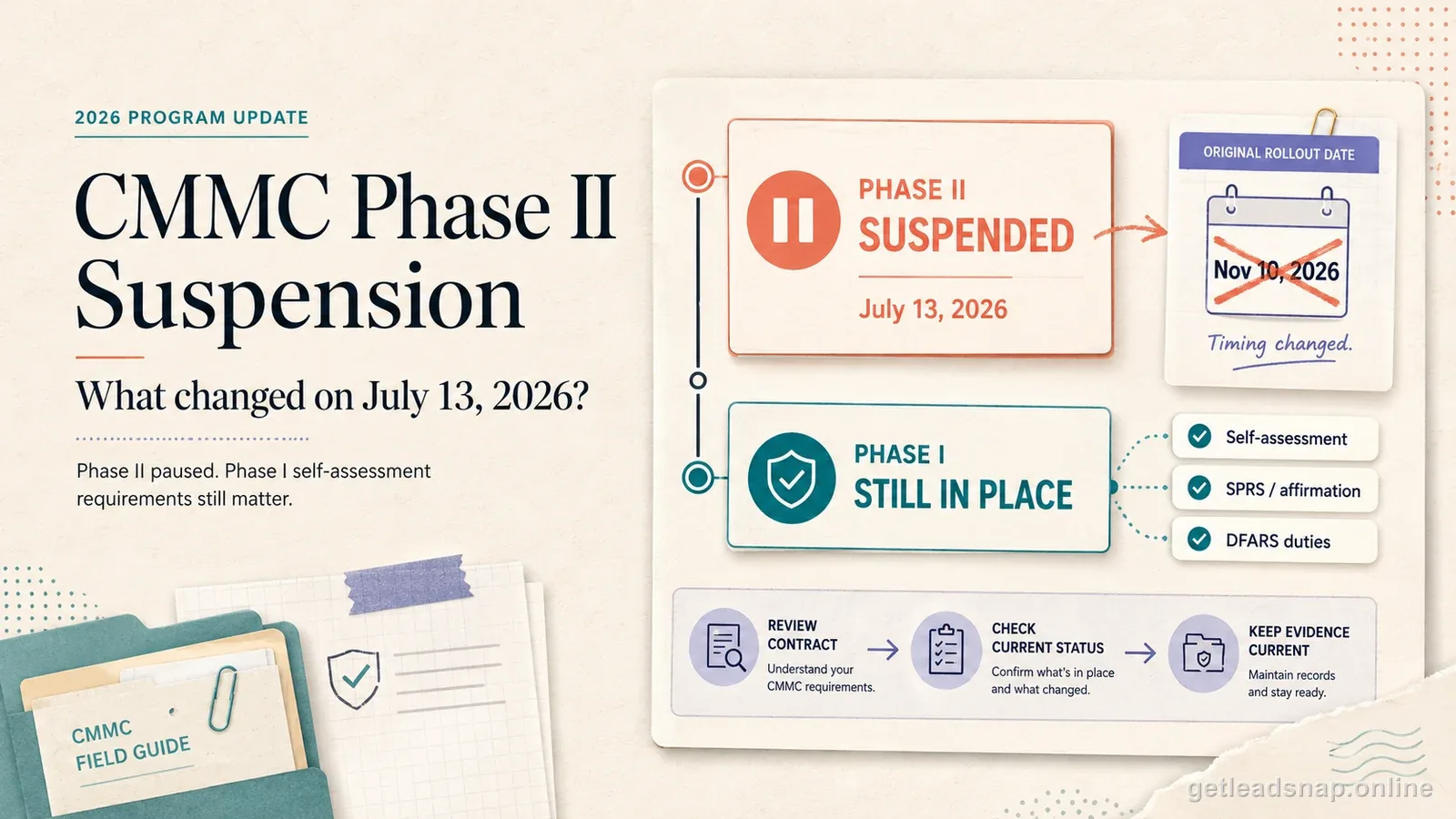
Current Status
CMMC Phase II Suspension: What Changed on July 13, 2026?
A plain-English guide to the July 2026 suspension of CMMC Phase II, what Phase I still requires, and what defense contractors should keep doing now.
Read guide →Practical articles for defense contractors, organized around the questions that cause real scope, evidence, proposal, and assessment problems. Updated for the July 2026 CMMC program change.
A plain-English guide to the July 2026 suspension of CMMC Phase II, what Phase I still requires, and what defense contractors should keep doing now.
Read guide →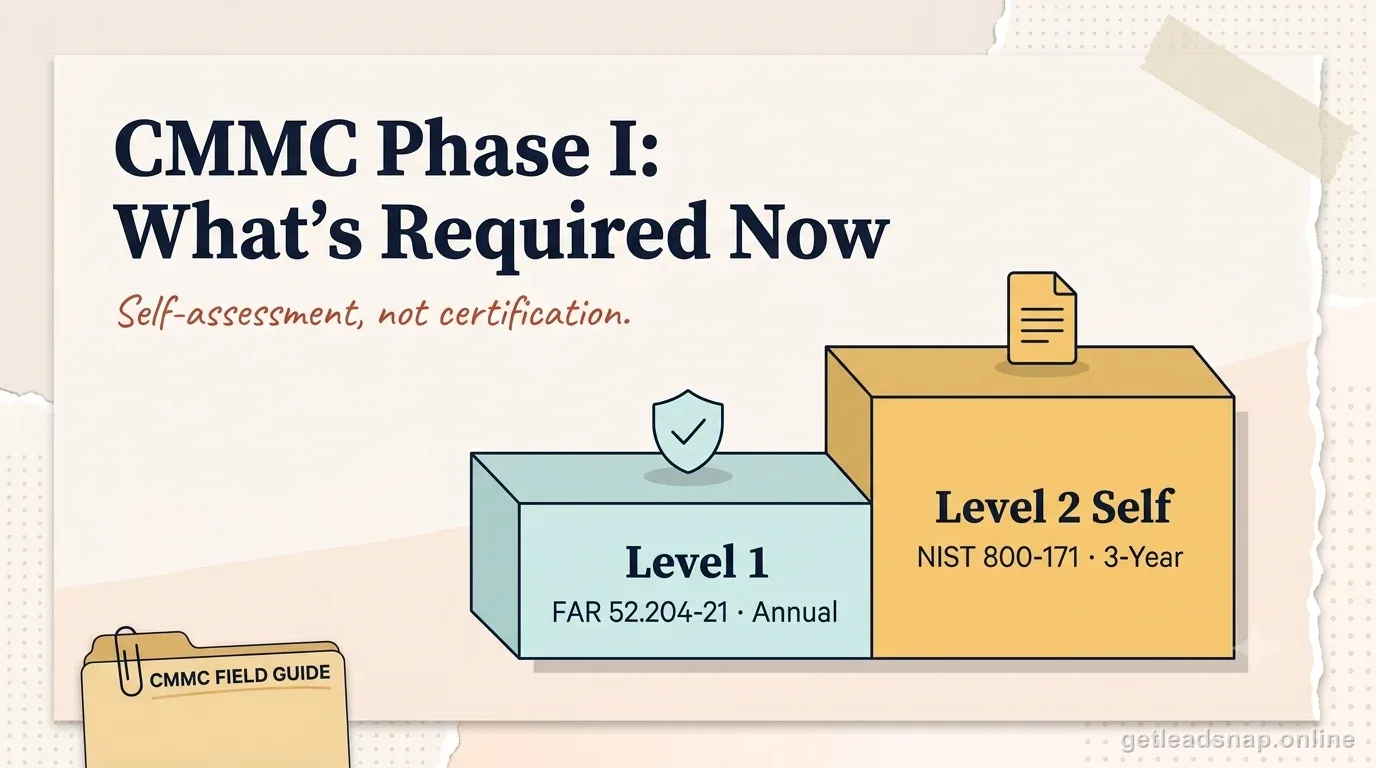
What Phase I means after the 2026 policy change, with a practical checklist for self-assessment, affirmation, SPRS, and award readiness.
Read guide →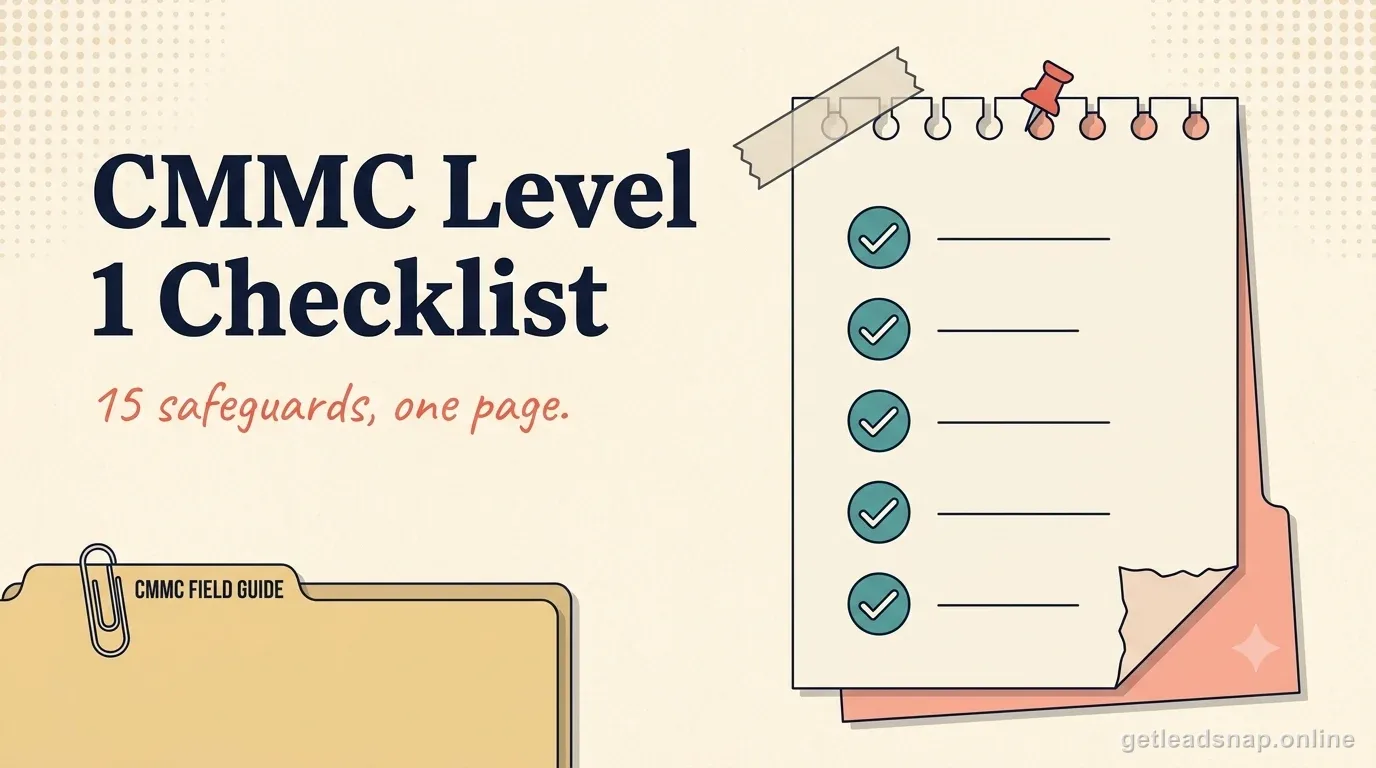
A focused Level 1 checklist for contractors handling FCI, based on the 15 FAR 52.204-21 safeguarding requirements and current CMMC self-assessment logic.
Read guide →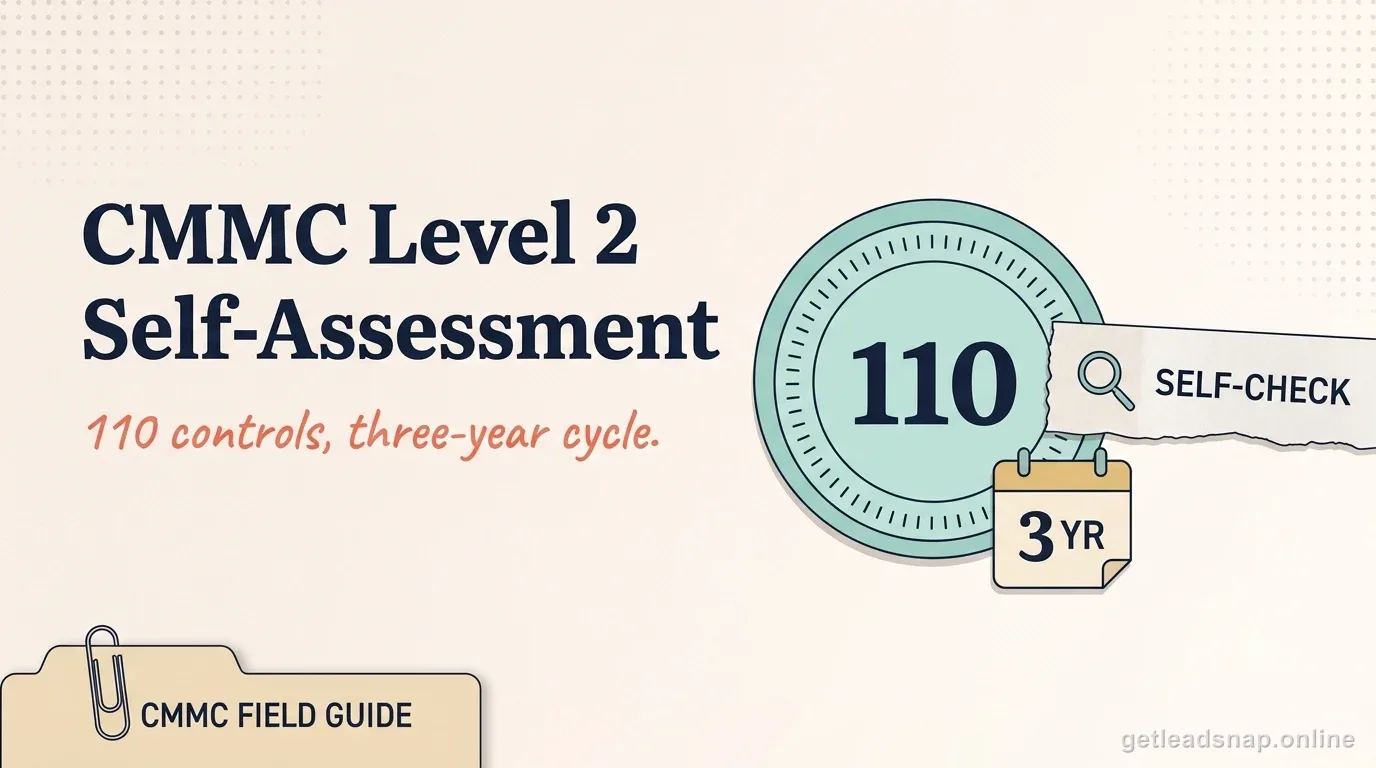
How Level 2 self-assessment works, what to scope, how to build evidence, and why current contract language matters in 2026.
Read guide →
Compare Level 2 Self and Level 2 C3PAO without relying on outdated rollout assumptions after the 2026 Phase II suspension.
Read guide →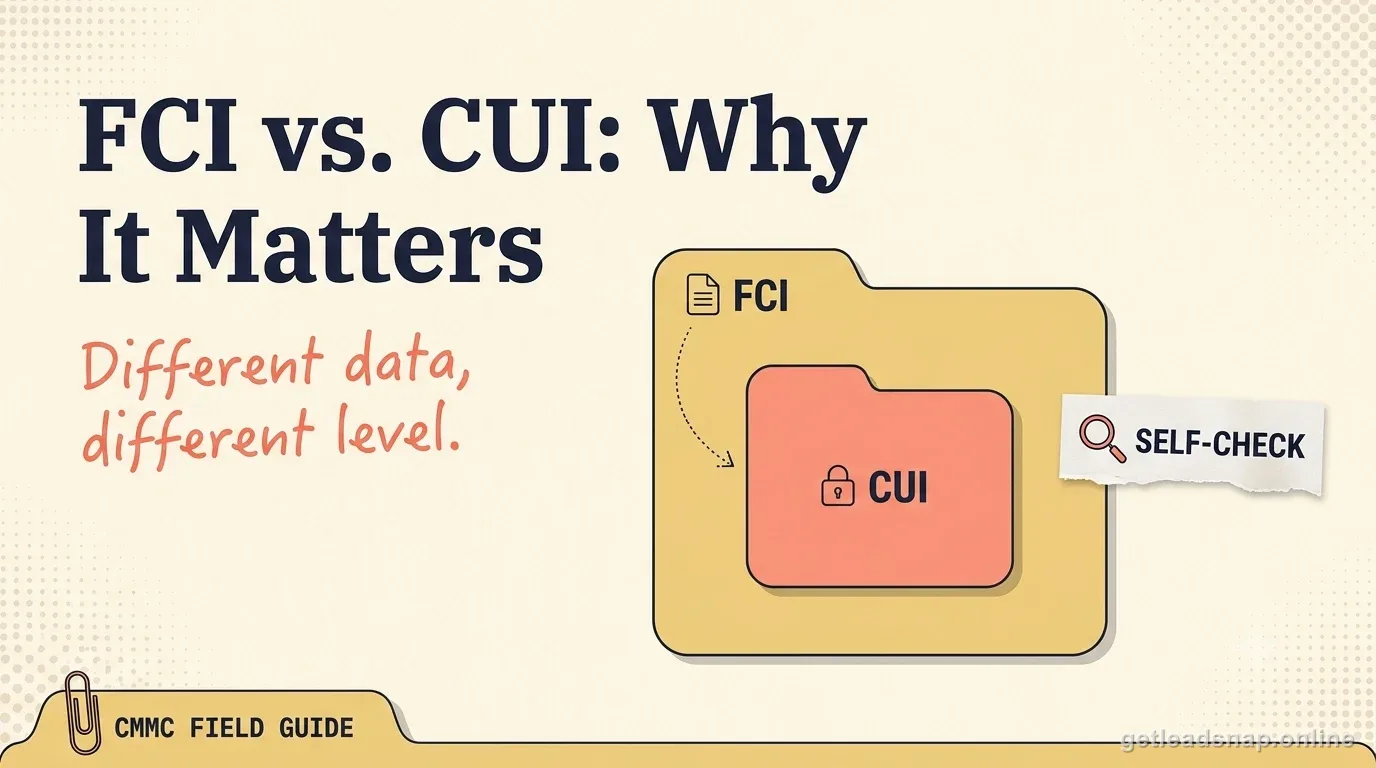
A data-first way to understand CMMC Level 1 and Level 2 by separating FCI from CUI before choosing controls, tools, or assessors.
Read guide →
A CMMC UID is the unique identifier tied to your assessed system's status record. Here's where it comes from, how to find yours, and when a solicitation requires one.
Read guide →
How current CMMC status, affirmations, and SPRS records connect to award eligibility when a solicitation includes CMMC requirements.
Read guide →
Why NIST Rev. 3 is final while CMMC work can still depend on Rev. 2, and how to avoid mixing assessment baselines.
Read guide →
A practical explanation of the current NIST SP 800-171 DoD Basic Assessment requirement, SPRS record, and three-year currency rule.
Read guide →
A bid-readiness workflow for checking NIST SP 800-171 assessment currency in SPRS before proposals, options, and extensions.
Read guide →
A small-business guide to safeguarding covered defense information, NIST requirements, cloud use, incident reporting, evidence preservation, and flowdown.
Read guide →
What the 72-hour reporting clock means, what to prepare before an incident, and how evidence preservation affects the response process.
Read guide →
A source-first explanation of the DFARS cloud requirement when an external provider stores, processes, or transmits covered defense information.
Read guide →
Read the CMMC contract clause as an operational checklist: current status, affirmation, system boundaries, POA&M closeout, and subcontractor handling.
Read guide →
How to read 252.204-7025 for the required level, SPRS status, affirmations, conditional status, and CMMC UIDs before bidding.
Read guide →
How the COTS-only exception works, why 'commercial' is not automatically 'COTS,' and what to verify before excluding cybersecurity clauses.
Read guide →
A practical method to scope systems that process, store, transmit, or protect CUI without turning the entire company network into the assessment boundary.
Read guide →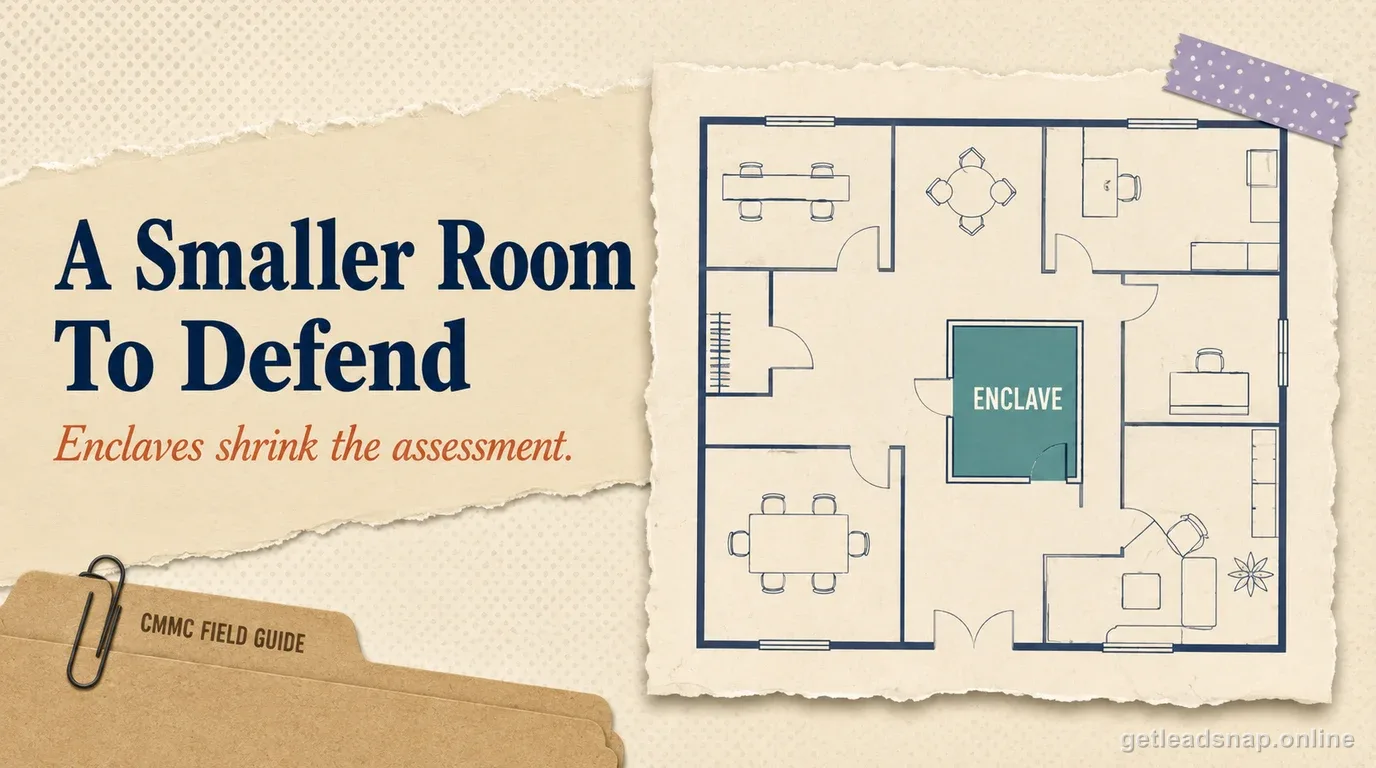
How a CUI enclave can reduce assessment complexity, what it does not solve, and which hidden dependencies often pull systems back into scope.
Read guide →
What remote work changes in a CMMC environment: endpoints, local storage, printing, networking, support, physical exposure, and evidence.
Read guide →
Why bring-your-own-device access creates CUI scope and evidence problems, plus safer patterns for small contractors that need flexibility.
Read guide →
How printers and multifunction devices can process or store CUI, plus the configuration and evidence questions teams often miss.
Read guide →
Why backups can silently expand CUI scope and how to document storage, encryption, access, retention, restoration, and provider responsibilities.
Read guide →
How to analyze managed service providers that administer, monitor, back up, or secure a CUI environment without assuming outsourcing transfers responsibility.
Read guide →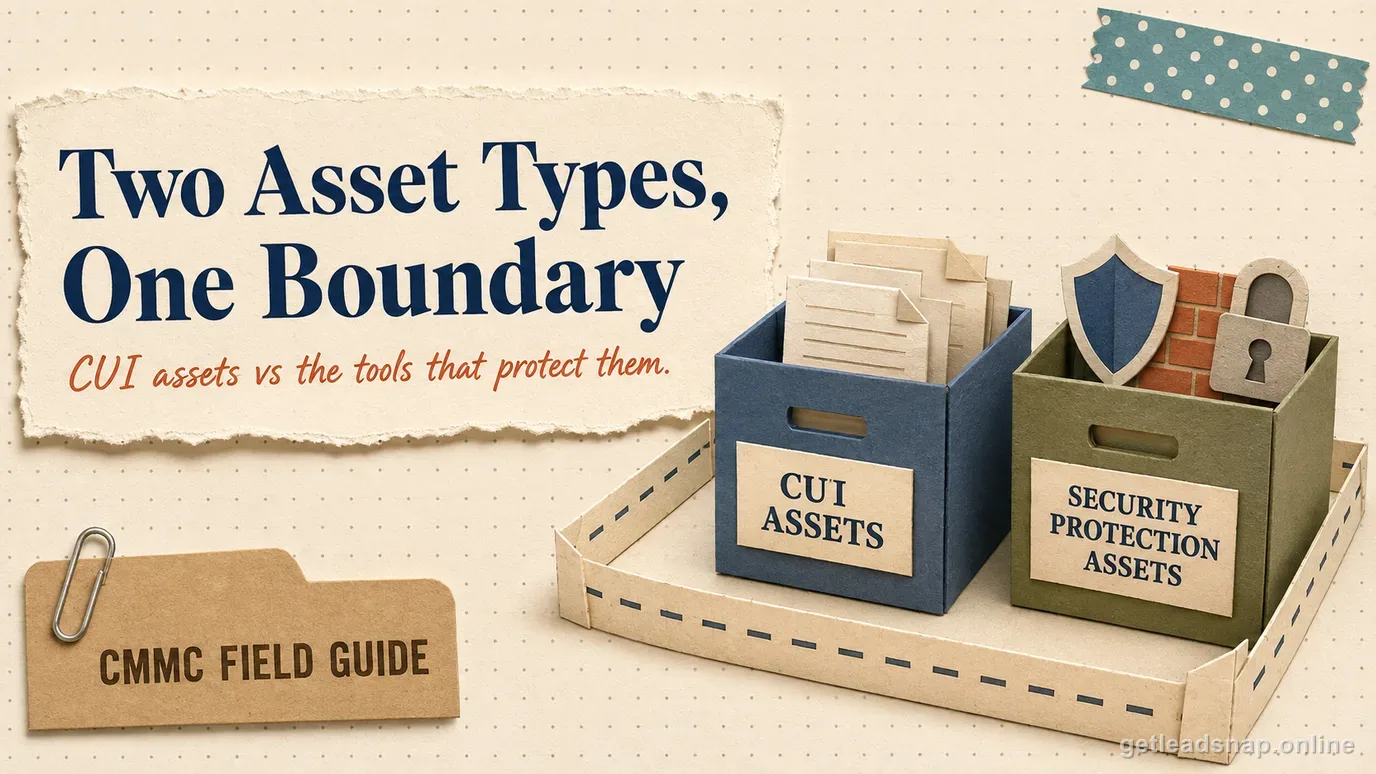
Separate the systems that hold CUI from the systems that protect them, with practical examples for identity, logging, EDR, firewalls, and management tools.
Read guide →
How to think about CMMC plans of action and milestones, conditional status, non-deferrable gaps, and the evidence needed for closeout.
Read guide →
A project plan for organizations that receive Conditional CMMC status and need to close eligible POA&M items within the program window.
Read guide →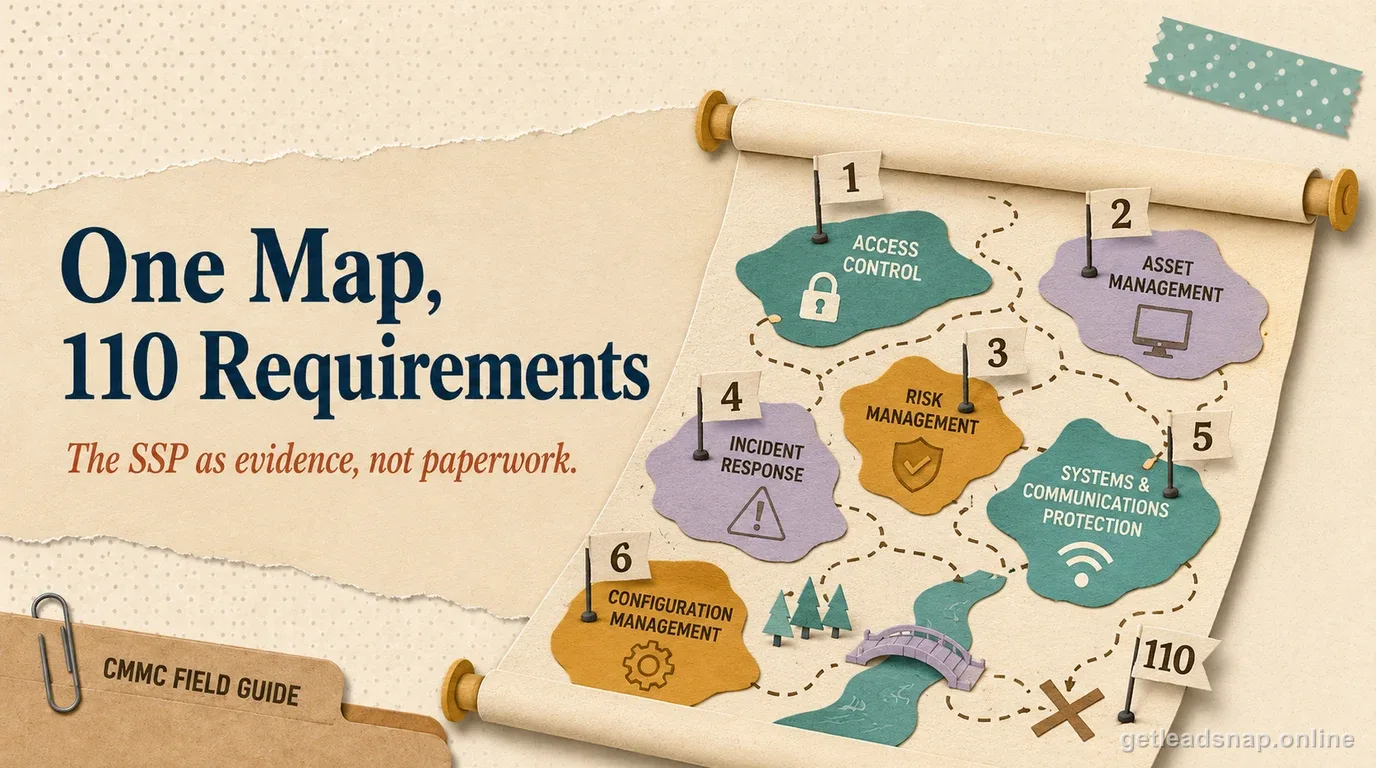
How to turn an SSP into a usable system description that connects scope, requirements, implementation owners, and evidence.
Read guide →
A practical evidence system for policies, configuration, logs, tickets, interviews, and observations—organized by requirement and owner.
Read guide →
The columns a small contractor needs to understand CUI scope, ownership, location, security role, data flow, and assessment status.
Read guide →
A lightweight evidence-index design that lets a small team answer assessment questions without digging through scattered folders.
Read guide →
A practical workflow for deciding when safeguarding and incident-reporting obligations need to reach subcontractors that handle covered defense information.
Read guide →
A practical guide to DFARS 252.204-7020 Medium and High NIST SP 800-171 DoD Assessments, contractor access duties, rebuttal timing, SPRS records, and subcontract implications.
Read guide →
Who qualifies as a CMMC Affirming Official, when affirmations are required, what is being attested to, and how to build a defensible internal sign-off process before SPRS submission.
Read guide →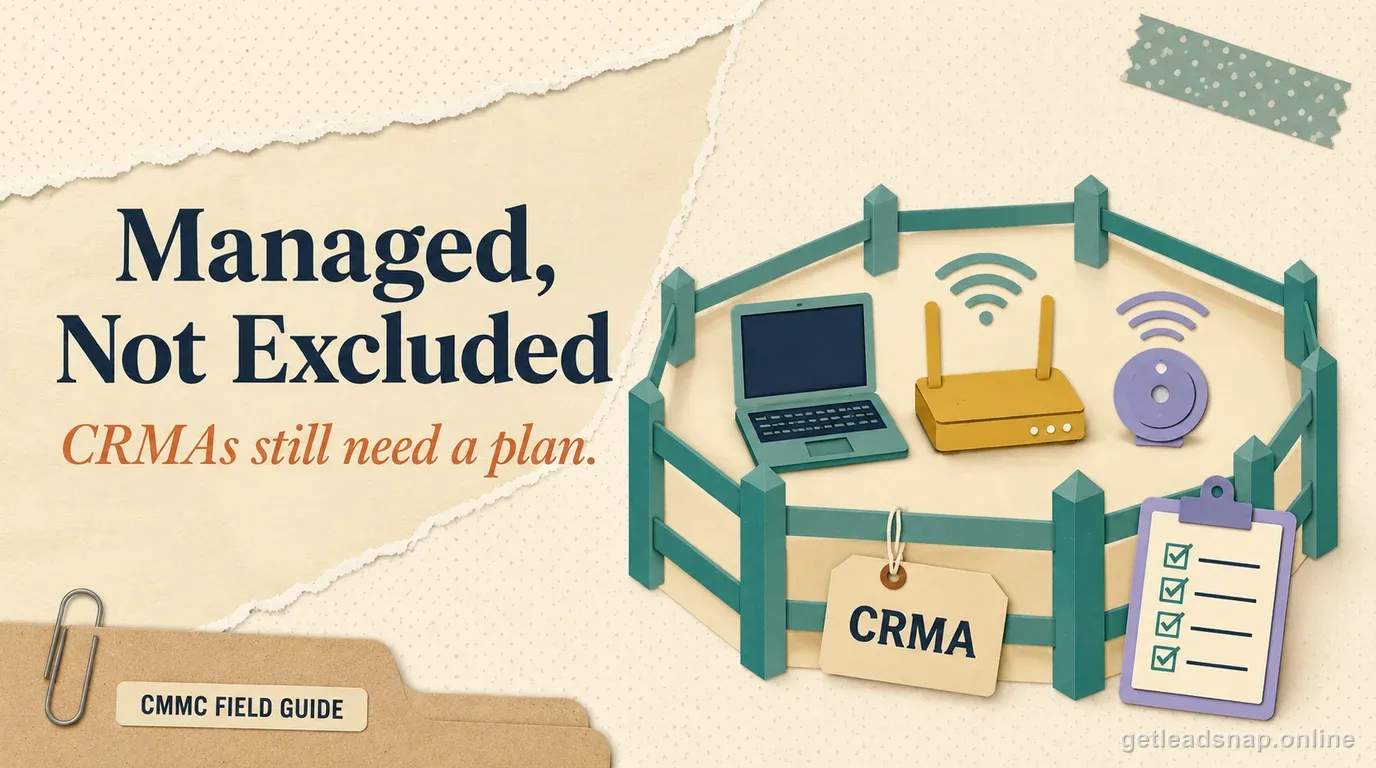
A focused Level 2 guide to Contractor Risk Managed Assets: what qualifies, why CRMAs stay in scope, what belongs in the SSP and network diagram, and when assessors can perform limited checks.
Read guide →
How CMMC Level 2 treats Specialized Assets such as OT, IoT/IIoT, Government Furnished Equipment, restricted systems, and test equipment that can handle CUI but cannot be fully secured.
Read guide →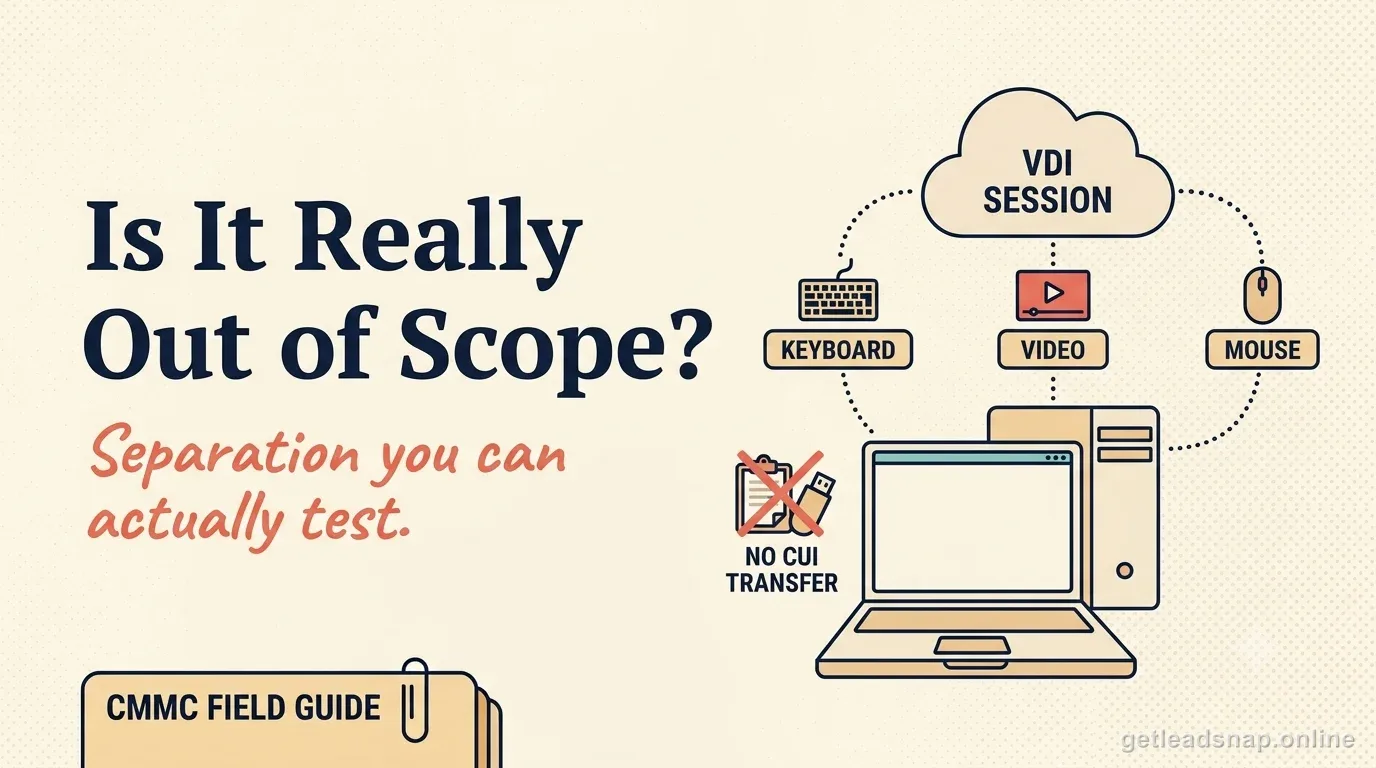
How Level 2 out-of-scope treatment works, what separation must accomplish, why 'no CUI intended' is not enough, and how the VDI keyboard/video/mouse condition affects endpoint scoping.
Read guide →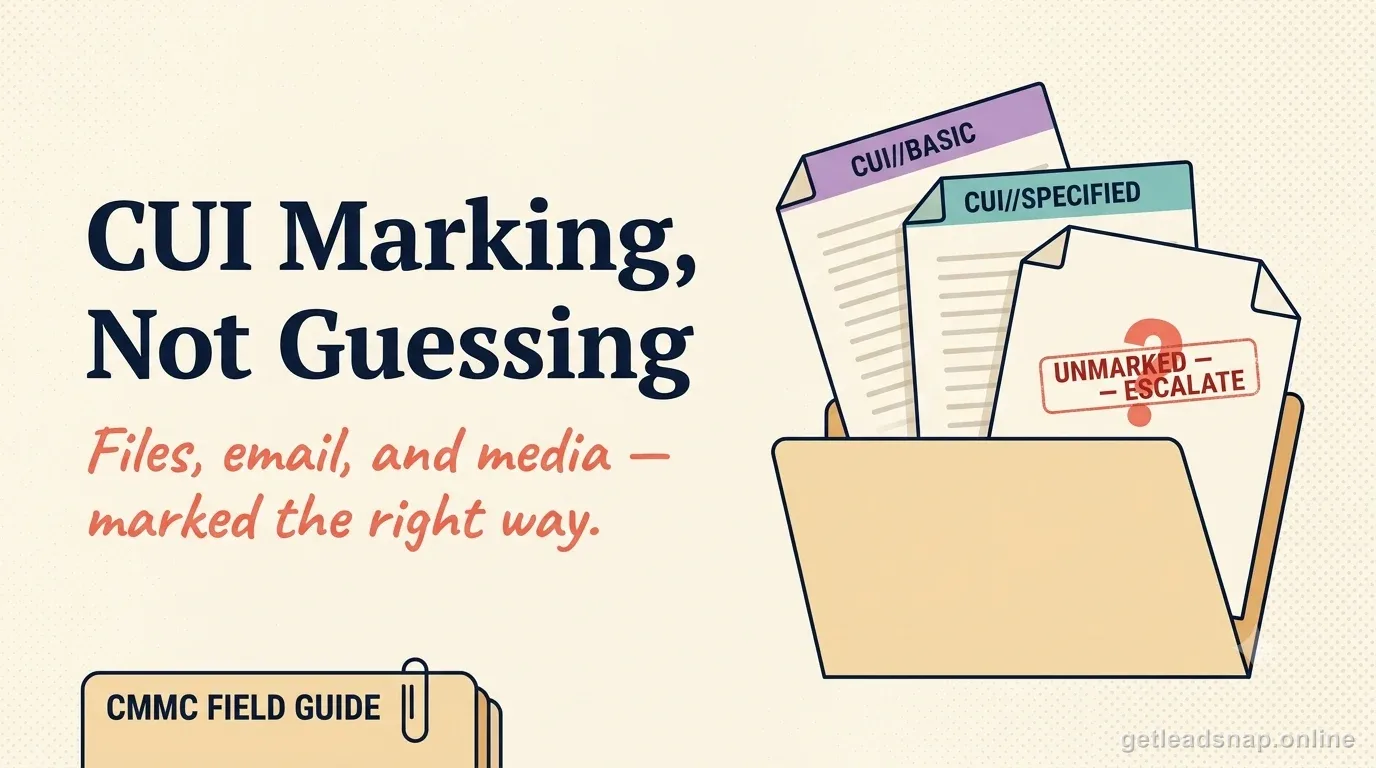
A contractor-focused CUI marking guide covering banner markings, Basic vs Specified CUI, email and media handling, source authority, and what to do when markings are missing or unclear.
Read guide →
A practical guide to handling CUI in email: when the mailbox enters scope, message bodies vs attachments, forwarding and mobile access, encryption, external recipients, and assessment evidence.
Read guide →
A precise guide to NIST SP 800-171 Rev. 2 requirement 3.5.3 for CMMC Level 2, including privileged vs non-privileged access, local vs network access, common bypasses, and assessor-ready evidence.
Read guide →
How CMMC Level 2 applies NIST SP 800-171 Rev. 2 least-privilege requirements to administrators, separate daily accounts, privileged functions, logging, approvals, and access reviews.
Read guide →
How shared logins and service identities interact with CMMC requirements for identification, unique user traceability, least privilege, authentication, and assessor evidence.
Read guide →
A practical guide to NIST SP 800-171 Rev. 2 audit requirements 3.3.1 through 3.3.9, including event selection, retention, user traceability, clock synchronization, log protection, failure alerts, and assessor evidence.
Read guide →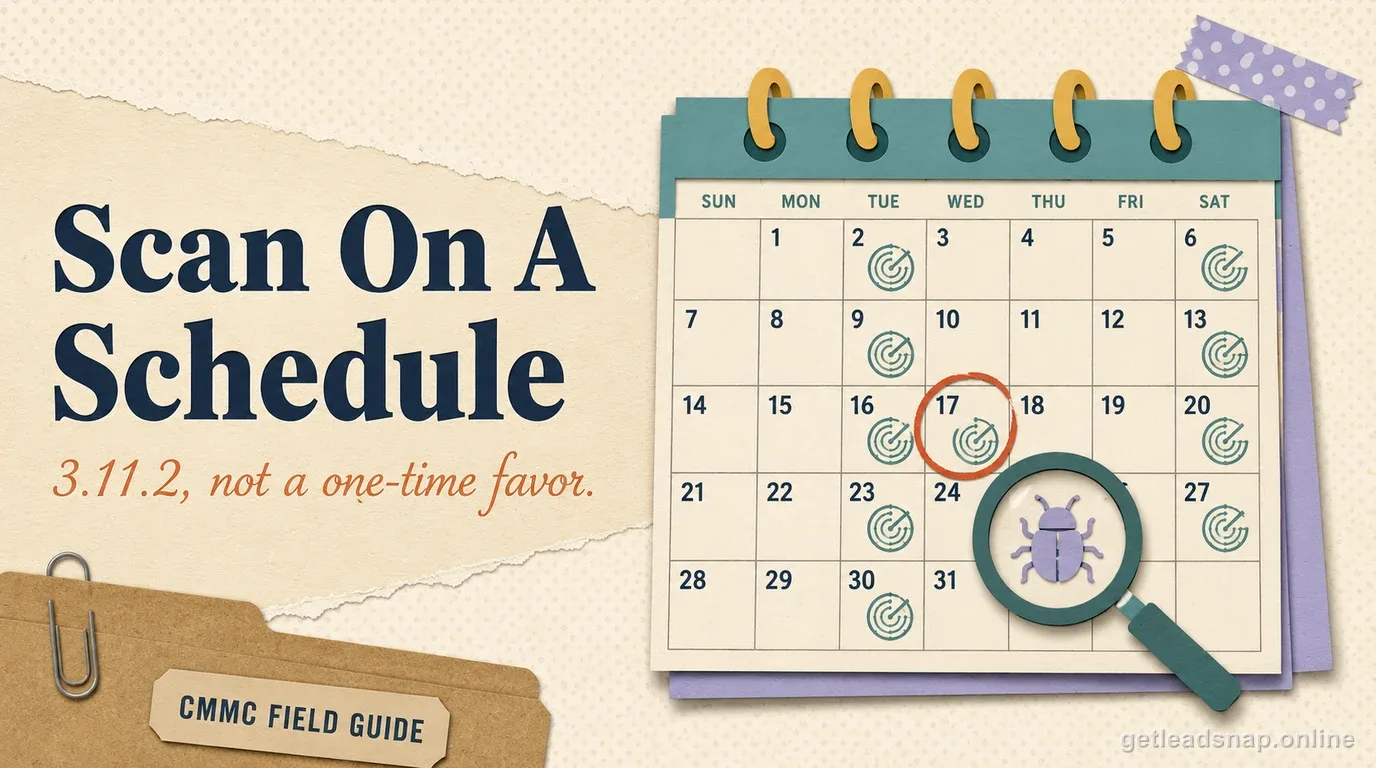
How to implement NIST SP 800-171 Rev. 2 requirement 3.11.2 without inventing a quarterly rule: systems and applications, periodic scans, new-vulnerability triggers, missed devices, exclusions, and evidence.
Read guide →
A focused guide to NIST SP 800-171 Rev. 2 requirement 3.14.1 and its relationship to vulnerability scanning and risk remediation, including patch SLAs, exceptions, emergency fixes, verification, and evidence.
Read guide →
A precise guide to NIST SP 800-171 Rev. 2 requirements 3.13.16 and 3.13.11 for CUI at rest, covering endpoints, servers, backups, cloud storage, removable media, key handling, physical safeguards, and evidence.
Read guide →
How to implement NIST SP 800-171 Rev. 2 requirements 3.13.8 and 3.13.11 for CUI in transit, including transfer-path inventory, alternative physical safeguards, FIPS-validated cryptography, TLS/VPN/SFTP configuration, and evidence.
Read guide →
A focused guide to NIST SP 800-171 Rev. 2 media requirements for USB drives and portable storage, including 3.8.7, 3.8.8, transport accountability, encryption, approved-device models, technical enforcement, and evidence.
Read guide →
How to implement NIST SP 800-171 Rev. 2 media sanitization requirements for drives, SSDs, paper, printers, equipment sent for maintenance, reused devices, and destruction records without confusing decontrol with public release.
Read guide →
How CMMC Level 2 applies NIST SP 800-171 Rev. 2 wireless requirements 3.1.16 and 3.1.17 to corporate Wi-Fi, guest networks, access points, rogue devices, remote sites, authentication, encryption, and assessment evidence.
Read guide →
A practical guide to NIST SP 800-171 Rev. 2 requirements 3.1.18 and 3.1.19 for mobile devices, including connection control, CUI encryption, MDM, apps, screenshots, local downloads, cloud backup, loss, remote wipe, and assessor evidence.
Read guide →
A detailed Level 2 tabletop guide for NIST SP 800-171 Rev. 2 incident response requirements 3.6.1–3.6.3, with scenarios, injects, roles, evidence, action tracking, DFARS 252.204-7012 reporting, and 90-day image preservation.
Read guide →
CMMC training under NIST 800-171 3.2.1–3.2.3 means role-aware and insider-threat-aware training with records proving people actually received it.
Read guide →
CMMC configuration management connects secure baselines, inventories, controlled changes, least functionality, and software restrictions across the CUI environment.
Read guide →
CMMC maintenance controls govern who services CUI systems, which tools are used, how remote maintenance is protected, and what happens before equipment leaves.
Read guide →
CMMC personnel security under 3.9.1–3.9.2 covers screening before access plus timely system and facility actions for termination and transfer events.
Read guide →
CMMC physical protection covers authorized facility access, visitor control, access logs, physical devices, and safeguards at alternate work sites.
Read guide →
CMMC account management should prove only authorized users and devices receive permitted access, with controlled provisioning, removal, and review.
Read guide →
CMMC session controls require inactivity locking with pattern-hiding displays and automatic termination after defined conditions, backed by real settings.
Read guide →
CMMC remote access requires controlled and monitored sessions, cryptographic protection, and routing through managed access-control points—not MFA alone.
Read guide →
CMMC 3.14.2 requires malicious-code protection at appropriate locations, with current configuration and operating evidence—not just an antivirus license.
Read guide →
CMMC 3.14.6–3.14.7 require monitoring for attacks and indicators of attack, plus a working process to identify and investigate unauthorized system use.
Read guide →
CMMC 3.11.1 requires periodic risk assessment to organizational operations, assets, and individuals—not merely a vulnerability scanner report.
Read guide →
CMMC 3.12.x requires recurring assessment, POA&M management, ongoing control monitoring, and an accurate SSP—not just a remediation list.
Read guide →
CMMC boundary protection under 3.13.1–3.13.5 requires controlled communications, architecture safeguards, separation, and public-system isolation.
Read guide →
NFO is a Rev. 2 tailoring category, not a hidden CMMC control set; learn what NIST expected nonfederal organizations to satisfy routinely.
Read guide →
CMMC scoping for voice, video, chat, meetings, and collaboration tools depends on whether the service processes, stores, or transmits CUI and how it is configured.
Read guide →
A useful CMMC data flow diagram shows where CUI enters, moves, is processed, is stored, exits, and which trust boundaries and providers protect each path.
Read guide →
2026 CMMC costs range from about $4k–$15k for Level 1 work to $75k–$300k+ for many Level 2 programs; these are market estimates, not official prices.
Read guide →
Choose a C3PAO by verifying authorization, independence, assessor roles, scope assumptions, evidence process, fees, scheduling, conflicts, and appeals.
Read guide →
CMMC software can organize evidence, mappings, tasks, and findings, but it cannot replace implemented controls, accountable owners, or authorized assessments.
Read guide →
A CMMC readiness self-check should confirm contract obligations, FCI/CUI, scope, assets, SSP accuracy, SPRS status, control ownership, and evidence gaps.
Read guide →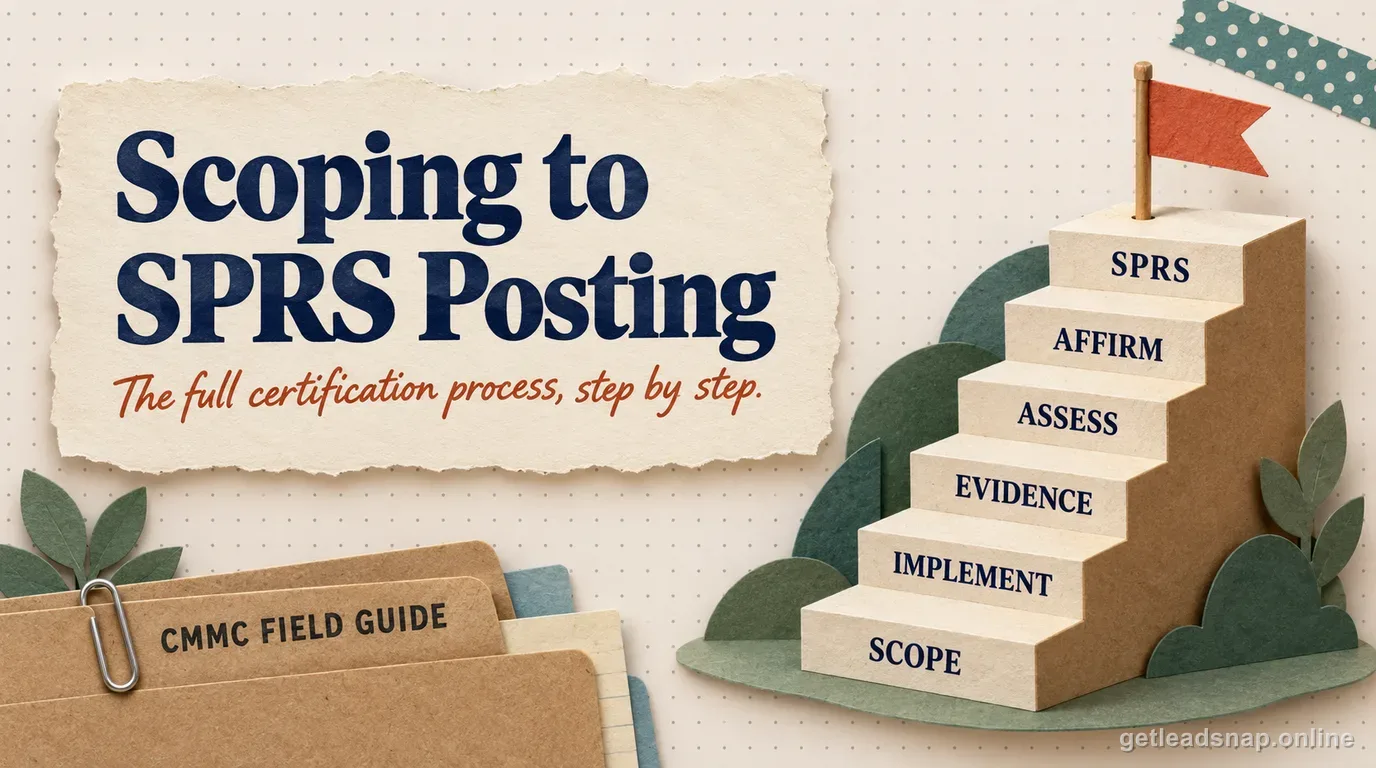
The CMMC process runs from contract and scope analysis through implementation, evidence, assessment, findings, affirmation, and required SPRS status updates.
Read guide →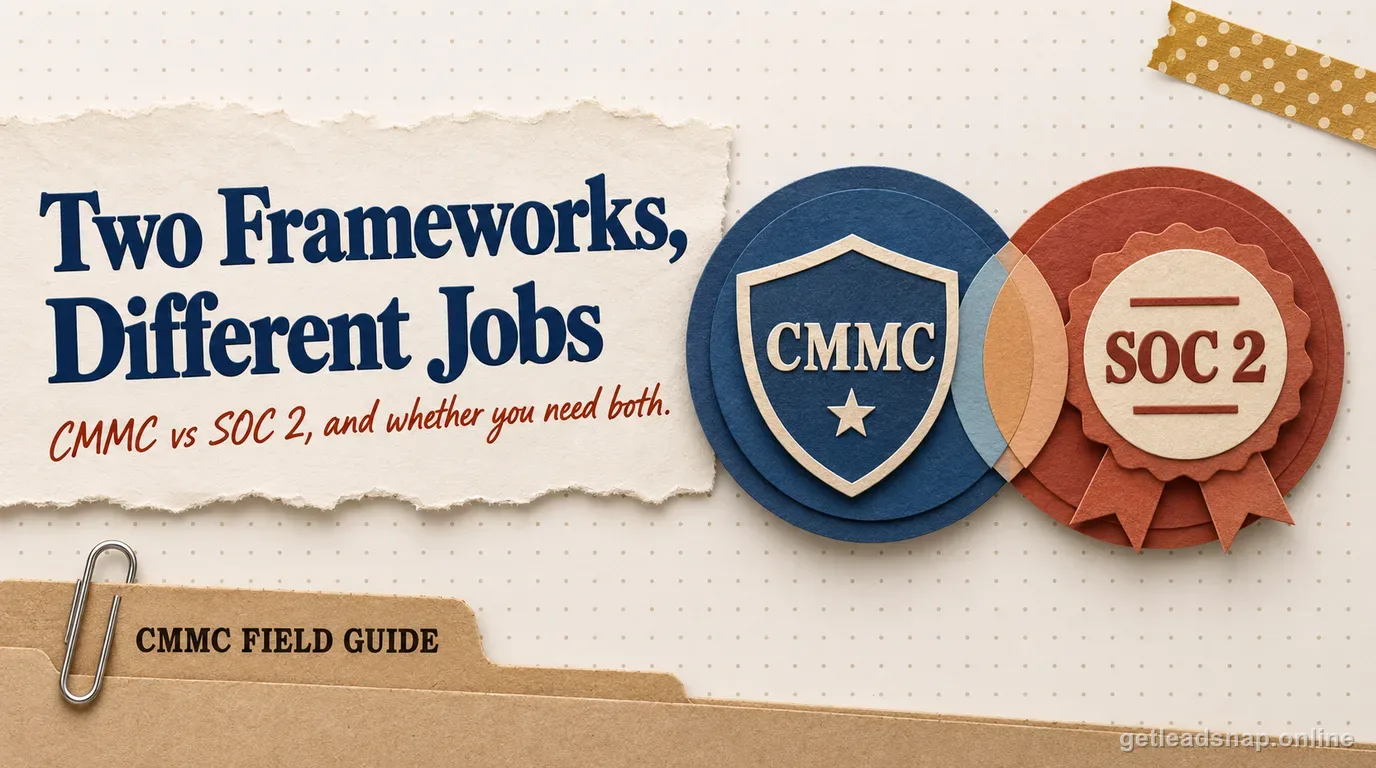
CMMC is a DoD contracting cybersecurity program tied to FCI/CUI; SOC 2 is an AICPA attestation framework. One does not automatically satisfy the other.
Read guide →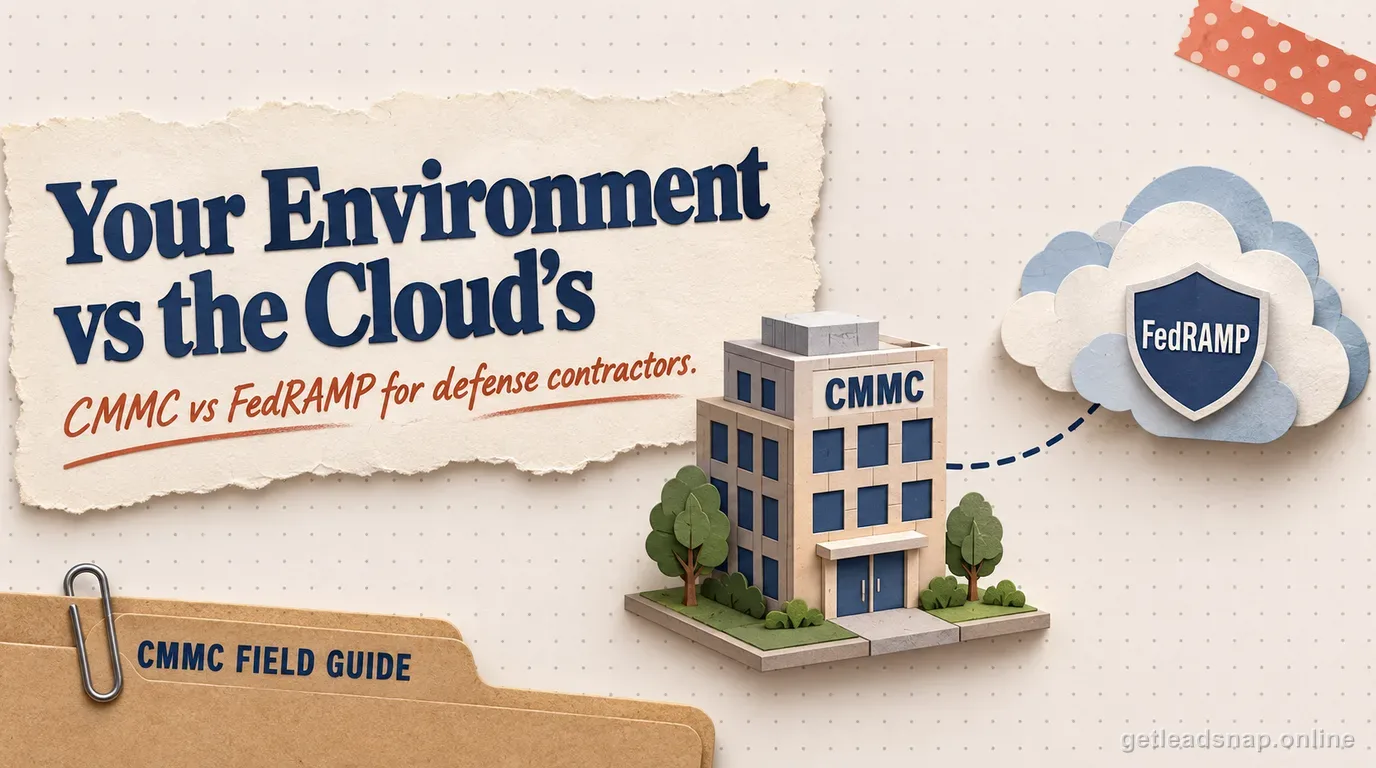
CMMC evaluates a contractor's protected environment; FedRAMP authorizes cloud offerings. Defense contractors may rely on both for different compliance purposes.
Read guide →
A consultant or Registered Practitioner can help prepare; a C3PAO conducts authorized certification assessments. Keep advisory and assessment roles distinct.
Read guide →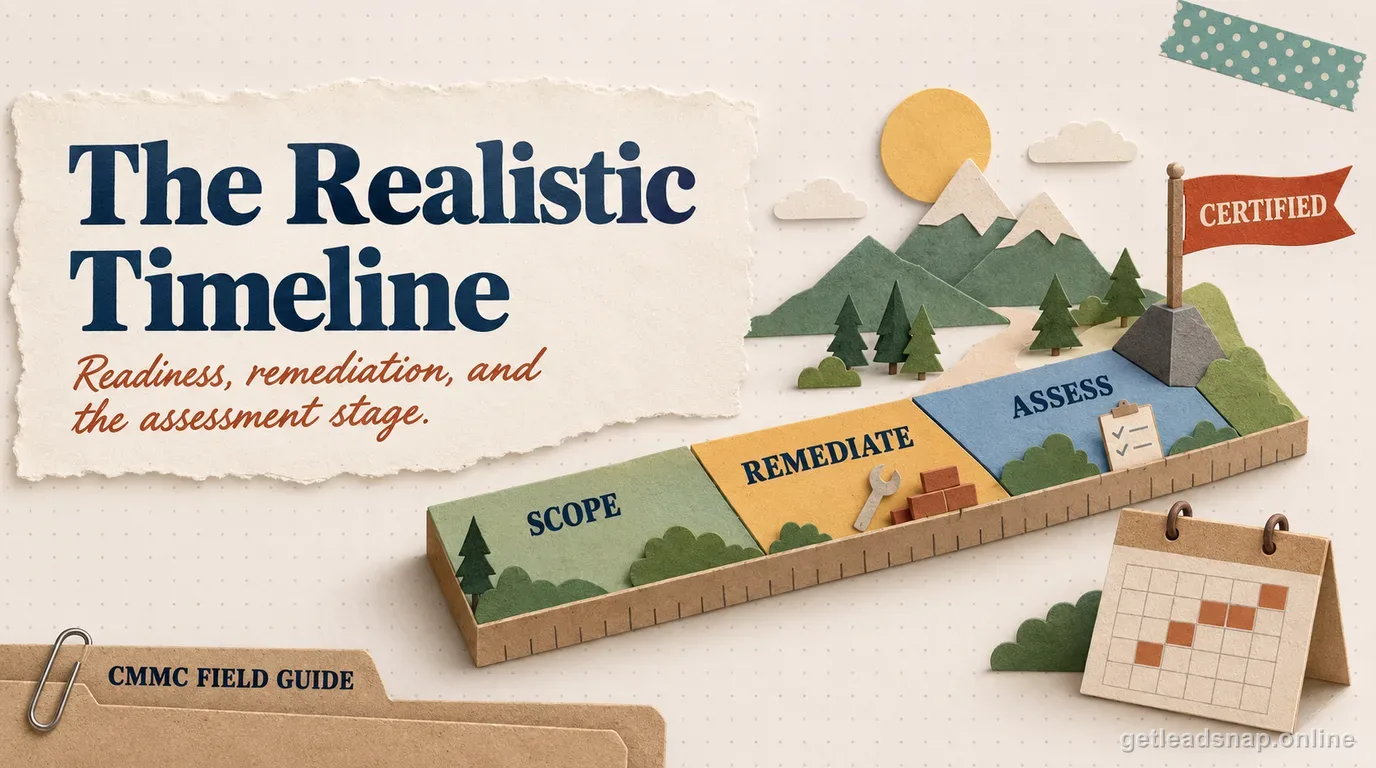
CMMC readiness may take months or longer depending on scope and remediation; the formal assessment is only one stage, and Phase II timing remains suspended.
Read guide →
A small-business CMMC budget should include scoping, remediation, tools, internal labor, provider changes, documentation, assessment, and recurring operations.
Read guide →
MSPs serving defense contractors should expect scrutiny of privileged access, tools, personnel, logs, incidents, cloud services, evidence, and client-specific scope.
Read guide →
Map CMMC shared responsibility control by control and service by service so the MSP and client know who implements each task and who retains the evidence.
Read guide →
MSPs can limit avoidable CMMC scope by minimizing CUI copies, separating privileged management paths, and using client-specific access and evidence workflows.
Read guide →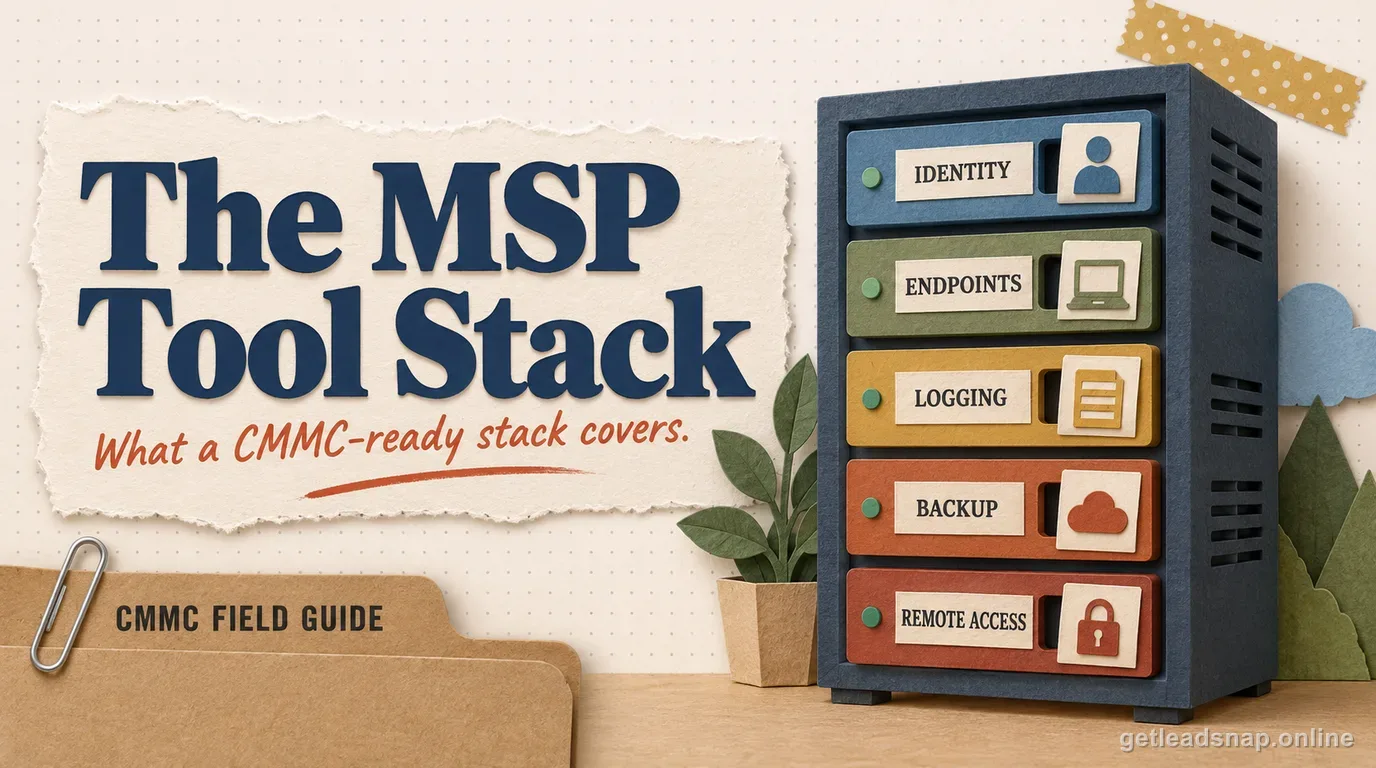
A CMMC-ready MSP stack should cover identity, endpoints, logging, vulnerability management, backup, secure remote access, change records, and usable evidence.
Read guide →
The CMMC Reform Task Force began July 13, 2026; as of September 4, no final report was posted on the official CMMC pages reviewed for this guide.
Read guide →
NIST SP 800-171 Rev. 3 is final, but current CMMC implementation remains anchored to Rev. 2; prepare for transition without claiming Rev. 3 is today's baseline.
Read guide →
Class Deviation 2024-O0013 Rev.1 directs contracting officers to use a DFARS 252.204-7012 deviation that requires NIST SP 800-171 Rev. 2 until rescinded.
Read guide →
If Phase II returns in a new form, contract triggers, scope, timing, or burden could change; as of September 4, 2026 no specific redesign has been adopted.
Read guide →
A prime's CMMC onboarding should identify protected data, applicable clauses, required status, approved systems and transfer paths, incident contacts, and flowdown.
Read guide →
Before signing, a subcontractor should clarify the protected data, clauses, CMMC status, approved systems, evidence expectations, incident duties, and cost impact.
Read guide →
CMMC scope in a teaming agreement or joint venture follows the entities, contracts, systems, and information flows actually used—not the relationship label alone.
Read guide →
Manufacturers should include shop-floor PCs, HMIs, PLC engineering stations, transfer paths, quality systems, and specialized assets when they touch or protect CUI.
Read guide →
QuickBooks or an ERP is not automatically in or out of CMMC scope; inspect its data, attachments, integrations, backups, users, and security role before deciding.
Read guide →
Microsoft 365 Commercial, GCC, and GCC High have different government compliance boundaries; choose by data and contract needs, then configure customer controls.
Read guide →
Google Workspace can support CMMC when in-scope FedRAMP High services and required controls are used, but customer configuration and operations remain essential.
Read guide →
Engineering firms should trace CAD, technical data, PDM/PLM, collaboration, rendering, and export-controlled information across every storage and transfer path.
Read guide →
With mixed contracts, map each solicitation's CMMC level and assessment status to the information system performing the work instead of assuming one result fits all.
Read guide →
A Level 2 evidence package should map each assessment objective to scoped assets, current implementation records, knowledgeable personnel, and testable controls.
Read guide →
CMMC results should use formal status terms such as Conditional and Final CMMC Status instead of informal 'interim pass' language that can obscure POA&M conditions.
Read guide →
If a CMMC assessment misses the required status, classify findings, check POA&M eligibility, fix root causes, validate evidence, and use the proper closeout path.
Read guide →
CMMC final statuses need recurring affirmations; a missed or stale affirmation can make an otherwise valid status non-current for contracting purposes.
Read guide →
A practical CMMC glossary covering SSP, POA&M, SPRS, C3PAO, DIBCAC, OSA/OSC, CMMC UID, FCI, CUI, CDI, ESP, MSP, MSSP, RP, and related terms.
Read guide →
CMMC Level 1 protects FCI, Level 2 protects CUI using the current Rev. 2 baseline, and Level 3 adds enhanced requirements for selected high-sensitivity programs.
Read guide →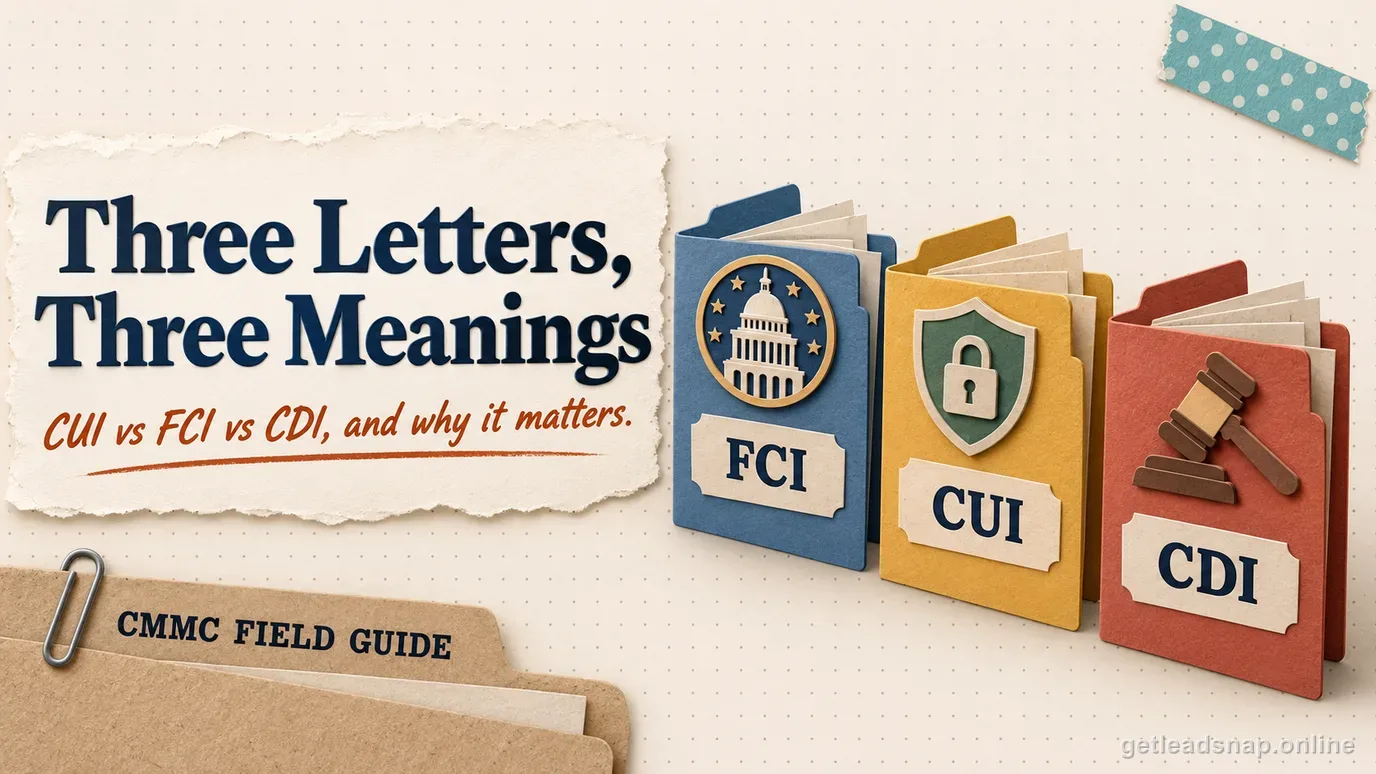
FCI is nonpublic federal contract information, CUI requires government safeguarding controls, and CDI is a DFARS term tied to covered defense information.
Read guide →