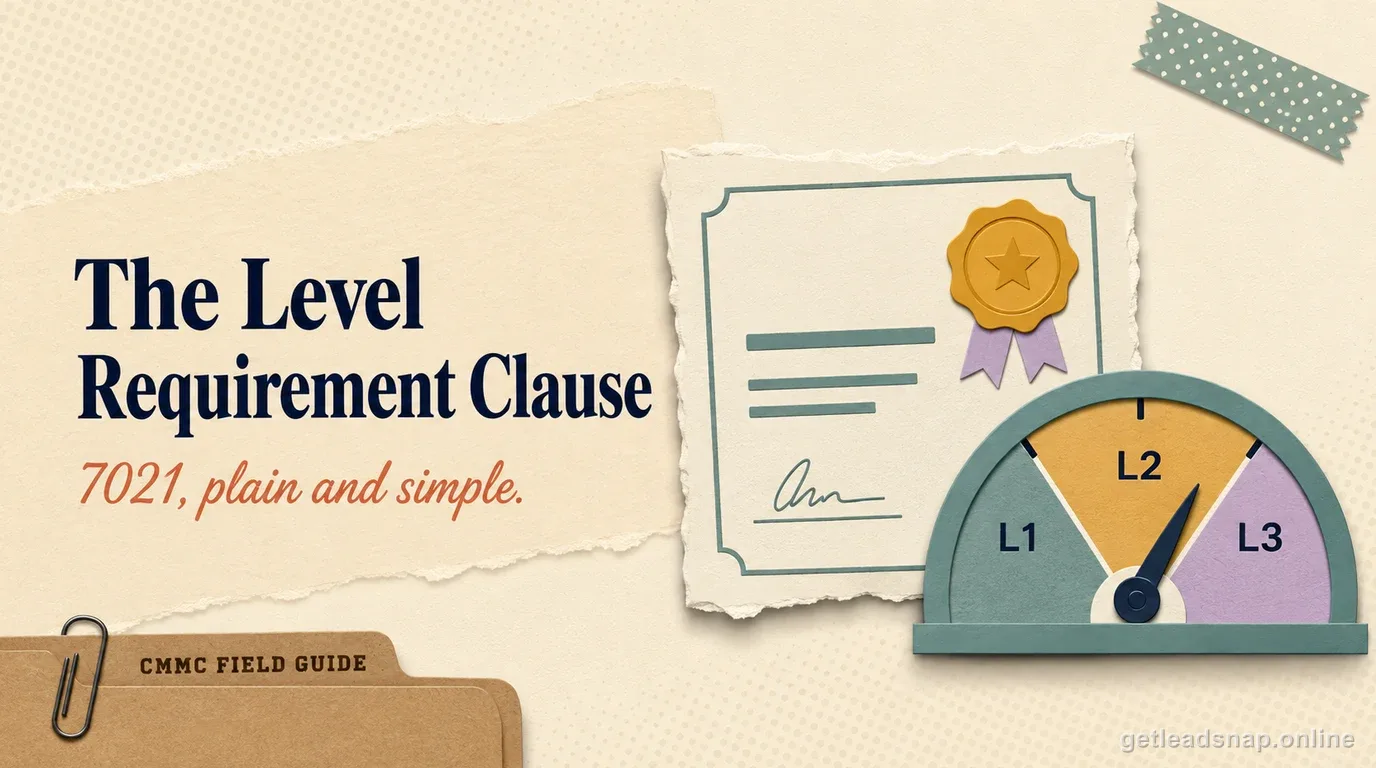
DFARS 252.204-7021 is the contract clause that carries CMMC requirements into contract performance when prescribed by the acquisition rules. For a small contractor, the most important idea is that the clause is system-oriented. The relevant question is not whether the company uses the phrase 'CMMC compliant,' but whether the contractor information system used for the work has the required current status and associated compliance records.
That system focus affects operations after award as well as the proposal. Assessment status, annual affirmation, conditional closeout, changes to the system, and subcontractor handling can all become business dependencies that need named owners and dates.
7021 is a contract clause, not the solicitation notice
The companion solicitation provision is DFARS 252.204-7025, which tells offerors what CMMC level the contracting officer has inserted and what information must be provided with the offer. 252.204-7021 then governs contractor compliance during the resulting contract when included. Keeping those roles separate makes clause reviews much easier.
In your contract abstract, list both provisions or clauses when present and summarize their operational effect. Proposal staff should know what must be shown before award, while program and security owners should know what has to remain true during performance.
Tie the required status to each performing system
Identify the contractor information systems that will process, store, or transmit FCI or CUI for the contract. Map each to its CMMC level, assessment type, UID, status, and owner. A company with separate corporate, engineering, manufacturing, or subsidiary environments may need more than one mapping.
Do not move contract work into a new tenant or enclave without reviewing that mapping. A technically secure system can still create a compliance problem if it is outside the assessed scope on which the contract relies. Add 'CMMC scope impact' to the change-management checklist for material architecture moves.
Affirmation needs an owner after award
Current CMMC rules require affirmation on defined schedules, including annual affirmation for Level 2. The assessment team may finish its project and disband, but the affirmation obligation continues. Put the date on the same contract calendar used for insurance, registrations, options, and other recurring business requirements.
Before affirming, confirm that the system has not materially drifted from the assessed condition. Review major architecture changes, unresolved security findings, scope changes, and the status of any conditional remediation. The affirmation should be treated as a management representation supported by current facts, not an automated anniversary task.
Conditional status is a countdown, not a backlog
When current CMMC rules permit conditional status, qualifying POA&M items must be closed within the allowed period. Program materials describe a 180-day closeout window for Level 2 conditional paths. That deadline belongs on the contract risk register because procurement, technical, and budget dependencies can all affect closure.
Track each item with a requirement reference, root cause, owner, target implementation date, validation method, and evidence-ready date. 'Ticket closed' is not enough. The control should operate in the assessed environment and be supported by the kind of evidence the closeout assessment requires.
Connect flowdown decisions to the actual data
CMMC and DFARS subcontracting responsibilities should be analyzed before information is shared. Procurement needs to know whether a supplier will receive FCI or CUI, which system will receive it, and what contract clauses or CMMC status are required for that work. Blindly adding the same cyber text to every purchase order obscures which suppliers actually carry the risk.
Maintain a supplier record that links the subcontract statement of work, information shared, approved transfer path, system owner, incident contact, and relevant compliance representation. Review it when scope changes or when a supplier moves work to a different platform or affiliate.
Make 7021 part of ordinary contract administration
At contract kickoff, confirm the performing system and status. Quarterly, reconcile major system changes and open conditional items. Before annual affirmation, perform a management review. Before an option or major modification, re-check whether the system and status still support the work. At closeout, remove unnecessary access and archive the compliance record with the contract file.
This operating rhythm is intentionally boring. That is a sign it is working. CMMC should not reappear only when a proposal is due or an assessor is scheduled; the clause is easier to satisfy when system ownership, dates, and information flows are maintained as routine contract data.
What operations should check after a system change
When IT proposes a material change to a system supporting a contract with 252.204-7021, add a CMMC impact review to normal change approval. Ask whether the change affects the assessment boundary, CUI or FCI flow, Security Protection Assets, the SSP, evidence mappings, conditional items, or the system identity used in contracting records.
A migration to a new cloud tenant, replacement identity provider, merger of networks, or change in managed service can have broader compliance impact than a routine software update. The change record should state whether the existing CMMC status still describes the performing system and who approved that conclusion.
If the change affects documentation but not status, update the SSP, asset inventory, responsibility matrix, and evidence index promptly. Waiting until the next annual affirmation can leave the organization affirming continuous compliance against records that no longer describe the architecture.
If the impact is uncertain, escalate before moving contract data. A temporary pause in a migration is usually cheaper than discovering after the fact that the contract work moved outside the assessed system.
Add the clause to the contract-transition checklist when responsibility moves from capture or proposal staff to the delivery team. The receiving program manager should know the performing system, current CMMC status, affirmation date, conditional items, supplier dependencies, and the security owner. Without that handoff, compliance facts gathered carefully during bidding can disappear as soon as the contract is won.
Document who has authority to change the performing system after award. Program managers sometimes move files or users to a different tenant because it solves an operational problem, without realizing the contract's CMMC representation was tied to the assessed environment. Requiring security review for material data-path changes keeps contract performance aligned with the system record relied upon at award.
Build the change trigger into contract administration: a new performing system, material boundary change, different CUI transfer path, provider replacement, or new subcontractor environment should force a CMMC impact check before the new architecture is used for contract work. That is the moment to reconcile the SSP, asset inventory, system identifiers, status, and supplier records—not months later when an assessor or customer asks why performance no longer matches the system relied on at award.
A short working check
- ✓Identify contracts containing 252.204-7021
- ✓Map each contract to an in-scope system
- ✓Track current CMMC status
- ✓Track affirmation dates
- ✓Manage Conditional status deadlines
- ✓Review flowdown based on subcontractor data handling
Common questions
Is 252.204-7021 only a proposal provision?
No. It is a contract clause. The companion solicitation provision is 252.204-7025.
Why should operations care about affirmation dates?
Because current affirmation is part of the CMMC compliance framework and can affect whether the required status remains usable for contracting purposes.
Does 7021 replace 252.204-7012?
No. The clauses address different parts of the cybersecurity and CMMC framework and may apply together in the same contract.
Official sources used for this guide
Open the primary source before making a contract-specific decision. Regulations and program implementation can change.