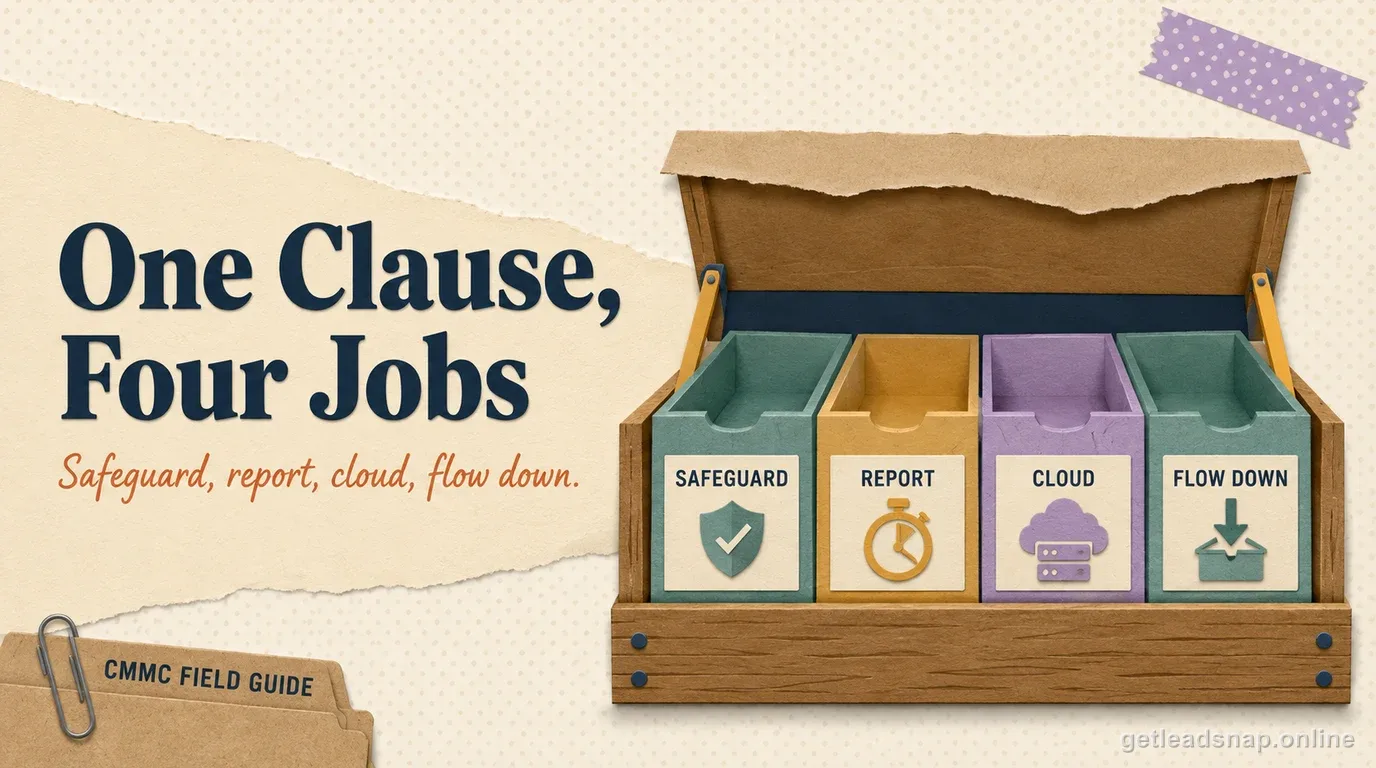
DFARS 252.204-7012 is one of the most important cybersecurity clauses a small defense contractor can receive because it combines ongoing safeguarding duties with incident-response obligations. It is not merely a requirement to submit a score, and it is not only something to read after a breach.
The clause applies to covered contractor information systems and covered defense information under its definitions. For systems not operated as Government IT services, it points to NIST SP 800-171 as the minimum security baseline subject to the contract's version and authorization rules, while also imposing cloud, reporting, preservation, forensic-support, and flowdown requirements.
The clause defines a covered contractor information system as an unclassified information system owned or operated by or for a contractor that processes, stores, or transmits covered defense information. Start by identifying the information rather than by reviewing every device in the company. The data path tells you which system needs the safeguarding analysis.
First determine whether you have a covered contractor information system
Covered defense information includes certain CUI tied to the contract. Preserve contract markings, data-delivery instructions, and the context in which the information was provided or created. If the business cannot distinguish covered defense information from ordinary commercial or public material, the technical team cannot build a reliable boundary.
NIST SP 800-171 is the minimum security baseline for the covered system
For covered contractor systems that are not Government-operated IT services, paragraph (b)(2) of the clause points to NIST SP 800-171. That obligation should be reflected in a system security plan that describes the actual environment, not a generic company policy. The SSP should identify the boundary, connections, components, responsible roles, and how requirements are implemented.
Keep the contract's baseline language with the SSP. NIST has newer publications, but the clause and current CMMC program can operate under transition rules. Your implementation record should say which revision is being used and why. Silent revision changes create assessment confusion and can make an otherwise strong environment difficult to defend.
External cloud use adds specific obligations
If an external cloud service provider stores, processes, or transmits covered defense information, 252.204-7012 requires security requirements equivalent to the FedRAMP Moderate baseline and requires the provider to support specified incident-related obligations. A marketing statement that a product is 'government ready' does not answer those contractual questions.
Procurement should obtain written evidence and contract terms that address the required security baseline, cyber-incident support, malicious software, media preservation, forensic access, and damage-assessment cooperation. Security architecture should then document the contractor-managed pieces around the cloud: identity, endpoints, integrations, exports, backups, and privileged administration.
The incident section starts a 72-hour operational clock
Under the clause, a cyber incident must be rapidly reported within 72 hours after discovery. Your incident plan therefore needs more than detection tooling. It needs named people who can determine whether covered systems or covered defense information may be affected, gather the required contract and system facts, and access the Government reporting mechanism outside normal business hours.
After the initial report, obligations continue. The clause addresses preservation of affected-system images and relevant monitoring or packet-capture data for at least 90 days from submission of the report, access for forensic analysis when requested, and handling of malicious software. Exercise those steps before an incident; the first test should not occur while the 72-hour window is running.
Flowdown follows the subcontract work and information
252.204-7012 includes subcontract flowdown provisions. A prime should determine whether a subcontractor will receive covered defense information or provide operationally critical support before data is shared. Simply inserting a clause into every purchase order without understanding the information flow creates paperwork but not control.
Maintain a subcontractor data-sharing register with the work performed, information category, approved transfer method, receiving system, incident contact, and flowdown basis. During offboarding, remove access and verify data return or destruction where required. This closes a gap that is often ignored once the subcontract deliverable has been accepted.
Turn the clause into six operating procedures
A small organization does not need a giant compliance manual. It needs repeatable procedures for identifying covered information, maintaining the covered-system SSP and evidence, approving external cloud services, reporting incidents, preserving forensic material, and flowing requirements to applicable subcontractors. Assign an owner and a backup owner for each.
Review those procedures against actual contracts at least annually and after major environment changes. The test is whether people can perform the clause under time pressure, not whether the clause number appears in a policy. If a new employee cannot explain where to report an incident or which cloud tenant is approved for CUI, the operational control needs work.
A clause-to-owner matrix small firms can actually maintain
Break 252.204-7012 into operational responsibilities and assign them to roles. Contracts owns identification of covered agreements and flowdown language. Security owns the covered-system SSP, NIST implementation, incident triage, and evidence. IT owns technical controls and preservation capability. Procurement owns external cloud and supplier diligence. Program management owns the data-sharing context and escalation from subcontractors.
For each role, name a backup. Small contractors are vulnerable to single-person dependencies: the one administrator with portal access, the one contracts manager who understands the clause, or the one provider contact who knows how to preserve logs. The clause does not pause because someone is on vacation.
Review the matrix during contract kickoff and after staff changes. Keep contact details and system references next to the responsibility, not buried in a separate employee directory. When an incident occurs, responders should not spend an hour discovering who owns the contract or where the DIB reporting credentials are kept.
Make the matrix part of contract administration
This matrix can remain one page. Its value is not legal analysis; it is translation from contract text into who does what on an ordinary day and during a bad day. A short operating map gives the team something executable; a clause summary by itself often does not.
For new contracts, add a 252.204-7012 kickoff check before covered information is received. Confirm the approved system, cloud services, incident contacts, reporting access, subcontractor data paths, and SSP owner. That short pre-use gate catches practical gaps at the point they matter most: before a user forwards the first sensitive file into the wrong environment.
For a small contractor, the most durable compliance artifact may be a clause-to-operation table kept by contracts and security together. One column names the clause duty, another names the internal procedure, another identifies the system or provider involved, and the last names the evidence or record produced. The table does not replace the SSP or the contract. It gives managers a compact way to see whether a legal obligation has an operational home instead of disappearing between departments.
A short working check
- ✓Confirm whether 252.204-7012 is in the contract
- ✓Identify covered defense information
- ✓Map covered contractor information systems
- ✓Review external cloud providers
- ✓Document the 72-hour reporting process
- ✓Review subcontractor flowdown before sharing data
- ✓Map each clause duty to an internal owner
Common questions
What does DFARS 252.204-7012 require?
DFARS 252.204-7012 requires safeguarding covered defense information using NIST SP 800-171, reporting cyber incidents to DoD within 72 hours of discovery, preserving relevant media and logs for review, meeting specific conditions for cloud service providers, and flowing the clause down to subcontractors handling covered defense information. It is a separate, ongoing contractual duty from the offer-time representation in DFARS 252.204-7008 and the assessment-posting mechanics in DFARS 252.204-7019 and DFARS 252.204-7020.
Does 252.204-7012 only matter during a cyber incident?
No. It contains ongoing safeguarding requirements as well as incident-response duties.
Can a normal commercial cloud service hold covered defense information?
Only if the applicable contractual security requirements are met. The clause specifically addresses external cloud providers and FedRAMP Moderate-equivalent security.
Did the July 2026 CMMC Phase II suspension remove 252.204-7012 duties?
No. The Phase II suspension changed CMMC implementation timing; an applicable 252.204-7012 clause still carries its own safeguarding, cloud, incident-reporting, preservation, and flowdown duties.
Official sources used for this guide
Open the primary source before making a contract-specific decision. Regulations and program implementation can change.