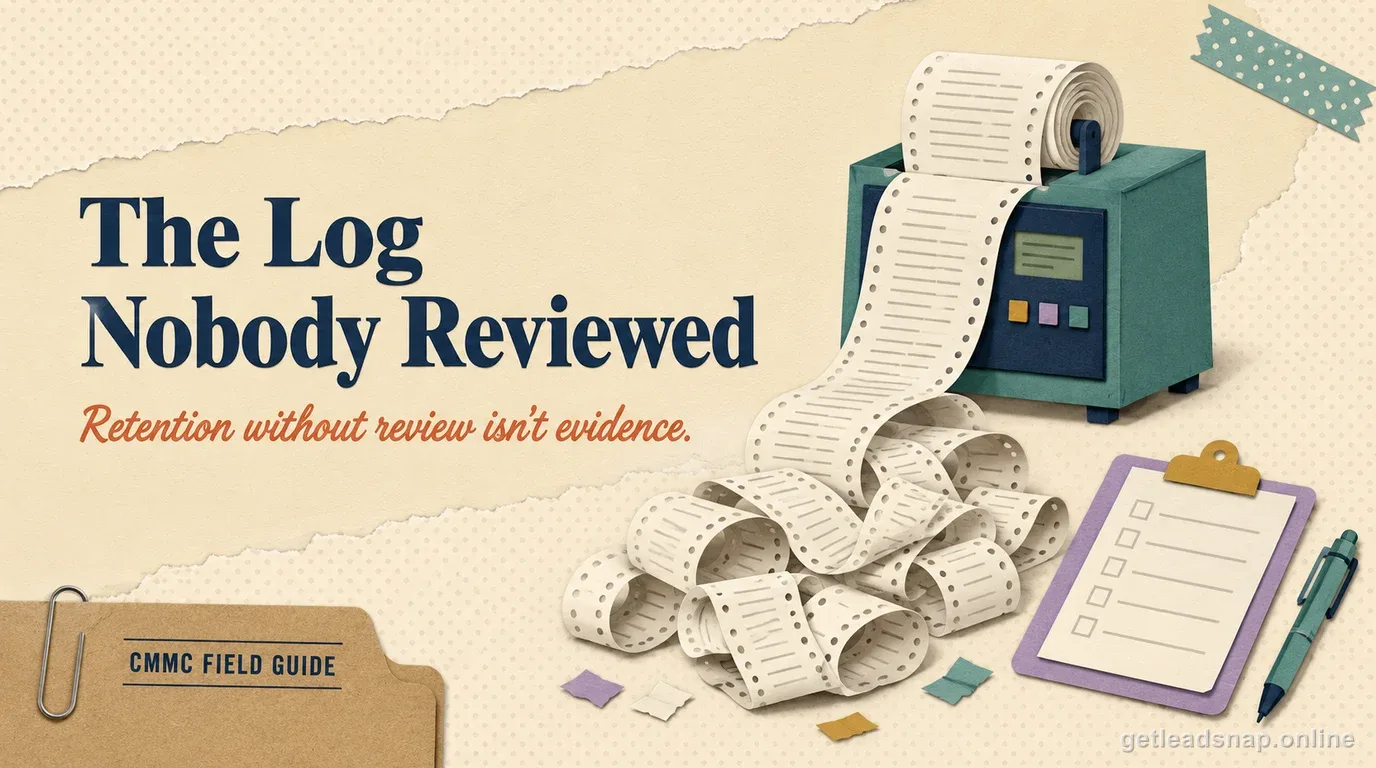
CMMC Level 2 does not reduce audit logging to a checkbox that says 'SIEM enabled.' The Audit and Accountability family in NIST SP 800-171 Rev. 2 asks the organization to create and retain records needed to monitor, analyze, investigate, and report unlawful or unauthorized activity; make individual user actions traceable; review the events being logged; alert on logging failures; correlate records; synchronize clocks; protect audit information; and restrict management of the logging function.
A small contractor can satisfy those objectives without buying the largest logging platform on the market, but only if it can explain what sources matter and why. A beautifully configured firewall log does not compensate for missing identity, endpoint, server, cloud-administration, or application events when those systems are part of the CUI environment. Conversely, collecting every possible event indefinitely can create cost and noise without improving investigation capability.
The useful design question is therefore not 'how many gigabytes of logs do we keep?' It is whether the company can reconstruct meaningful security activity across the assessed scope and prove that the logging system itself is controlled.
Build the event catalog from investigation questions
Start with the events an investigator would need after a suspected compromise: successful and failed authentication, MFA and account changes, privilege assignment, creation or deletion of users, administrative actions, endpoint security detections, firewall or VPN connections, access to sensitive repositories, configuration changes, software installation, security-tool disablement, and relevant application actions. The exact catalog depends on the systems in scope, so document the selection instead of copying a generic list from another company.
For each source, identify the system owner, events enabled, destination, time source, retention setting, and who reviews or can administer the logs. This turns logging from an abstract policy into an inventory that can be sampled during assessment. Include cloud services and appliances that hold security functions; an identity provider, firewall, backup console, or EDR service can be just as important as a Windows event log.
Review the catalog when the environment changes. A newly adopted SaaS repository or remote-access tool can become a major evidence source the day it enters the CUI workflow. If its administrative and authentication events never reach the logging plan, investigators may have a blind spot even though older systems remain well covered.
- Who authenticated, from where, and with what result?
- Who changed privilege, policy, or security configuration?
- Who accessed, created, moved, or deleted sensitive data where the platform records it?
- Which endpoint/process generated an alert or administrative action?
- What happened immediately before and after the event?
Do not invent a universal retention period
Requirement 3.3.1 requires retaining audit records to the extent needed for monitoring, analysis, investigation, and reporting. It does not state a single number such as 90 days, one year, or seven years for every contractor. The assessment procedure expects the organization to determine what retention is needed and then verify that records are retained accordingly.
Set retention deliberately. Consider how long incidents may go undetected, contractual or legal obligations that apply to the business, the time needed to investigate supplier or customer notifications, storage cost, and the ability to search older data. A design might use different hot-search and archive periods, but the SSP or logging standard should describe the actual arrangement rather than claiming an aspirational number the systems do not meet.
Test retention with old records, not only with a configuration screenshot. Select a source, search for an event near the oldest date that should still be available, and confirm it is readable and attributable. This catches silent data rollover, licensing caps, connector outages, or archive jobs that look correct on paper but have already discarded evidence.
Preserve individual traceability across systems
Requirement 3.3.2 focuses on tracing actions to individual users. Unique usernames help, but traceability can break when administrators share credentials, applications log only a role name, service accounts are used interactively, or a remote-support gateway hides the person behind one common account. Identify those paths and add a mechanism that binds the human user to the recorded action.
Correlate identity, endpoint, network, and application records using fields that remain stable enough for investigation. User ID, device name, source address, session ID, event time, and target object are often more useful together than any one record alone. Requirement 3.3.5 specifically addresses correlating audit review, analysis, and reporting processes for investigation and response.
A practical test is to select one real administrative change and reconstruct it. Show who authenticated, from which managed device or access path, what privileged action occurred, and whether the timestamps line up. If the team must infer the operator from a meeting calendar or shift roster, the logging design needs stronger attribution.
Keep the record trustworthy enough to investigate
Requirement 3.3.7 calls for a system capability that compares and synchronizes internal system clocks with an authoritative source to generate timestamps for audit records. Time drift makes otherwise good evidence difficult to correlate. Document the authoritative source or hierarchy and verify that important devices actually synchronize to it, including network appliances and isolated systems that may not inherit the same configuration as domain-joined endpoints.
Requirement 3.3.4 requires alerting if an audit logging process fails. A log collector that quietly stops receiving events for two weeks is not providing the intended assurance. Monitor connector health, agent status, storage capacity, dropped-event conditions, and other failure modes relevant to the design. Define where the alert goes and who has to investigate it.
Include failure testing in normal operations. Disconnect or safely stop a test log source, trigger the condition, and confirm the responsible person receives an actionable alert. Record the test and restoration. The assessor can then see both the configuration and evidence that the control path works.
Requirements 3.3.8 and 3.3.9 protect audit information and limit management of audit functionality to a subset of privileged users. Separate the ability to use a system from the ability to delete or rewrite its security history. Centralized forwarding can help by moving records away from the endpoint an attacker might control, but the central platform also needs access restrictions and change logging.
Define distinct roles for log viewers, security analysts, and logging administrators when the platform supports them. An analyst may need to search events without changing retention or disabling ingestion. An infrastructure administrator may manage a server without receiving permission to erase the central copy of its audit trail.
Capture configuration changes to the logging platform itself: disabled sources, new exclusions, retention changes, role changes, or collector modifications. Review those events with the same seriousness as changes to a firewall rule because weakening the evidence layer can be part of an attack.
- Time synchronization and timezone consistency
- Restricted log administration
- Alerting on collection failure
- Protection against unauthorized deletion or alteration
Assemble assessor evidence that proves operation, not just configuration
Prepare a logging standard or procedure, source/event inventory, retention rationale, diagrams or data-flow notes for central collection, time-synchronization configuration, failure-alert examples, role assignments, and representative audit records. Match artifacts to the relevant 3.3.x objectives rather than dumping a large SIEM export into an evidence folder.
Use recent samples from several technology classes: identity, endpoint, server, network, cloud service, and any important CUI application. Demonstrate a privileged action, a failed authentication, a security event, a configuration change, and a logging failure or health check where practical. Redact unrelated sensitive data in working evidence copies without changing the facts being demonstrated.
Finally, compare the source inventory with the current CMMC scope and network diagram. Logging evidence should follow the same boundary as the systems being assessed. Missing sources are easier to fix before an assessment than while an assessor is asking why an in-scope system has no usable audit trail.
A short working check
- ✓Maintain a source and event catalog for the CUI environment
- ✓Define and test the retention period needed for investigations
- ✓Use individual attribution for human activity
- ✓Synchronize important systems to an authoritative time source
- ✓Alert on logging or collection failures
- ✓Protect audit records from unauthorized modification or deletion
- ✓Limit management of audit functionality to designated privileged roles
- ✓Keep representative audit samples mapped to 3.3.x objectives
Common questions
Does CMMC require one fixed log-retention period?
NIST SP 800-171 Rev. 2 requirement 3.3.1 does not prescribe one universal number. The organization determines retention needed for monitoring, analysis, investigation, and reporting and must be able to demonstrate that its systems meet the defined retention.
Do all logs have to be in a SIEM?
The requirement is about the audit capability and evidence, not a named product. Central collection can simplify correlation, protection, and review, but the contractor should show how every important in-scope source is covered regardless of platform.
Why are shared admin accounts a logging problem?
They can prevent the organization from uniquely tracing an action to the individual user. If a legacy shared credential is unavoidable, an additional mechanism should reliably bind the human operator to the session and resulting actions.
Should every system keep logs for the same number of days?
Not necessarily. Define retention from investigation, contractual, operational, and storage needs for each log source or class. What matters is that the organization can explain the chosen period and can show the configured and observed retention matches it.
Official sources used for this guide
Open the primary source before making a contract-specific decision. Regulations and program implementation can change.