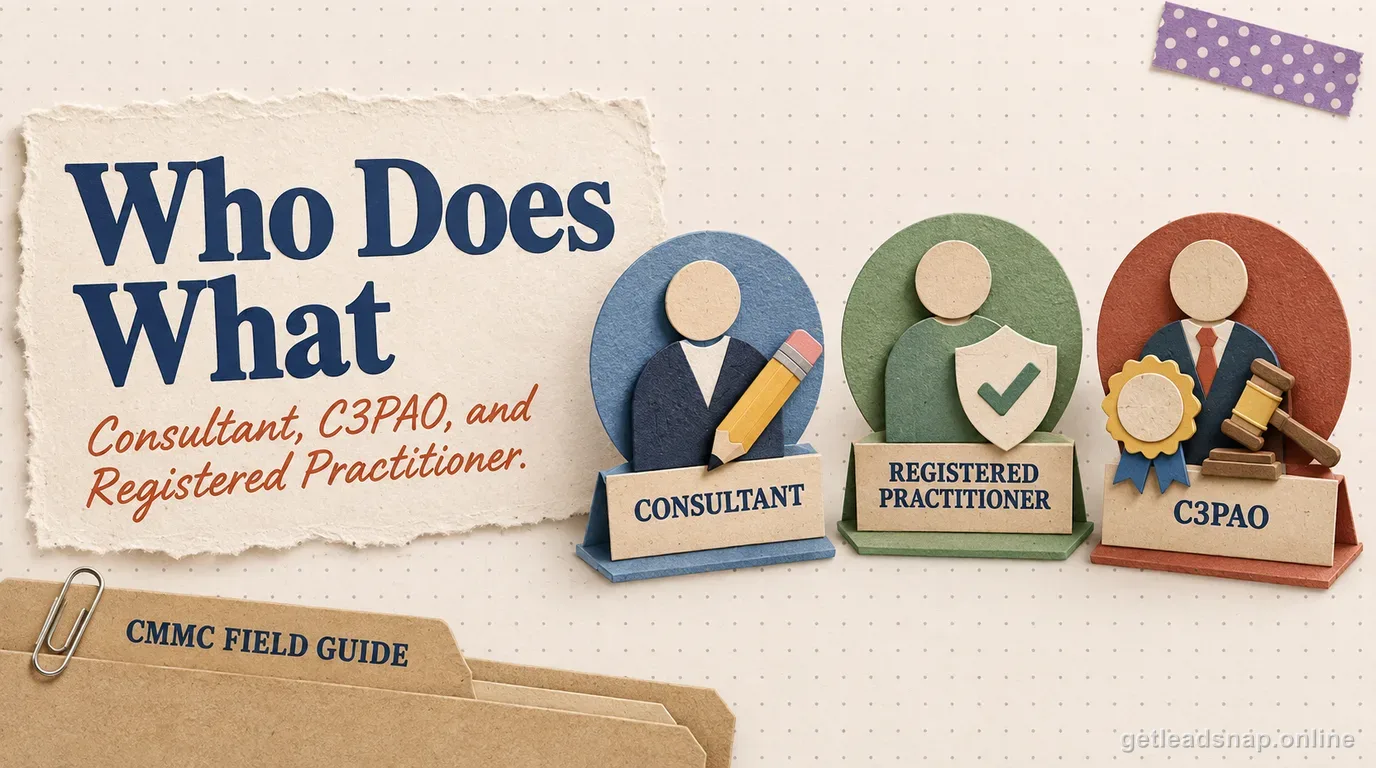
Preparation and assessment are different services. Consultants and Registered Practitioners can help an organization understand, scope, document, and implement CMMC requirements; a C3PAO performs authorized certification assessments using qualified assessment personnel.
In practice, the question that matters for a small defense contractor is narrower: does the requirement map to a specific control inside the FCI/CUI boundary, is an owner assigned, and is there current evidence it is actually operating?
The rule in plain English
The Cyber AB describes RPs/RPOs as consultative and C3PAOs as assessment organizations. An RP designation signals ecosystem training, but it is not the same role as a certified assessor or C3PAO.
An organization can also perform much readiness work internally. The right outside role depends on the gap: interpretation, implementation, program management, or formal assessment.
How to implement it without overbuilding
Write the statement of work so the role is explicit. For advisors, define deliverables such as gap analysis, implementation support, evidence organization, or mock assessment. For a C3PAO, define the assessment boundary and authorized assessment work.
Check conflicts before engaging the same people across preparation and assessment.
What evidence to keep
Keep role/credential verification, scopes of work, conflict checks, work products, and the source basis for recommendations.
Require advisors to distinguish 'required by source' from 'recommended by us.'
Where teams get into trouble
The worst failure is paying for a 'CMMC certification consultant' and assuming that consultant can issue CMMC status. Another is accepting mandatory-sounding advice with no source citation.
Small-contractor walkthrough
A small business needs help writing an SSP and remediating gaps, then later needs an authorized assessment. It should contract separately for advisory work and assessment work, verify ecosystem roles, and avoid language that makes a consultant sound as though it can issue certification status.
For readiness, choose a normal business example rather than a perfect demonstration environment.
- Define the service needed.
- Verify role/credentials.
- Separate advice from assessment.
- Require source-backed recommendations.
Consultant, RP/RPO, and C3PAO are not interchangeable labels
The Cyber AB describes Registered Practitioner Organizations as consultative organizations that employ Registered Practitioners and do not conduct Certified CMMC Assessments. RPs provide consultative preparation services. C3PAOs occupy the assessment role. A general consultant may have substantial CMMC experience without being an RP, while an RP designation does not turn that individual into an assessor who can issue a CMMC certification outcome.
Define the need before selecting the role. Scoping analysis, SSP support, remediation planning, evidence organization, policy design, and program management are advisory or implementation work. An authorized Level 2 certification assessment is different work. Verify the C3PAO and assessment personnel through the current ecosystem rather than buying a 'certification package' from an advisory provider and assuming it creates official status.
Separate advice, implementation, internal validation, and formal assessment
One advisor can interpret requirements, an MSP can implement technical controls, and the contractor can run an internal readiness review. Those activities still do not become the formal C3PAO assessment. Keeping roles visible helps the organization distinguish an assessor requirement from a consultant's preferred design and from an actual obligation in NIST, 32 CFR, DFARS, or the contract.
Require advisory deliverables to distinguish 'required by source' from 'recommended implementation.' A consultant may prefer a specific SIEM, timeout value, cloud architecture, or managed service. Unless a controlling source or the contractor's documented risk decision requires that exact choice, it should not be sold as the only compliant solution.
Procure outside help so the contractor can operate without permanent dependency
Before signing, verify role status, exact statement of work, conflict or independence concerns, deliverables, ownership of work products, and whether the provider will access CUI or Security Protection Data. If an advisor needs privileged access to live systems, map that path just as carefully as any other external administrator and determine whether it affects provider scope.
A strong engagement leaves behind source-cited decisions, a prioritized remediation backlog, an accurate SSP, reusable evidence, and staff who understand their controls. A weak engagement leaves a spreadsheet that only the consultant can interpret. Require handoff sessions, evidence locations, control owners, and assumptions to be documented so the contractor can defend its own environment.
For formal assessment planning, ask the C3PAO about scope inputs, evidence logistics, assessment team, independence, scheduling, and what information must be ready before the event. Do not ask the assessor to become the implementation consultant during the assessment or promise an outcome before the evidence is examined.
Last-mile depth check
For advisor selection, ask who will own each recommendation after the consultant leaves. A recommendation with no internal owner, source citation, acceptance decision, or closure evidence becomes another unmanaged backlog item. The final deliverable should therefore map every recommendation to a contractor decision rather than merely ranking findings by severity.
A short working check
- ✓Define the service needed.
- ✓Verify role/credentials.
- ✓Separate advice from assessment.
- ✓Require source-backed recommendations.
- ✓Check conflicts.
- ✓Keep final responsibility in-house.
Common questions
Can an RP certify us?
No. Registered Practitioners provide consultative support; authorized C3PAOs conduct Level 2 certification assessments.
Do we need an RP to prepare?
No designation is universally required for a contractor's readiness work.
Can a C3PAO also consult?
Independence and conflict rules matter. Keep preparation and assessment roles separated for the same organization.
What should a good consultant deliver?
Source-backed gaps, implementation actions, ownership, and evidence needs—not merely generic policies.
Can a Registered Practitioner issue a CMMC certification?
No. The RP role is consultative; formal certification assessments are conducted through the authorized C3PAO assessment ecosystem.
Official sources used for this guide
Open the primary source before making a contract-specific decision. Regulations and program implementation can change.