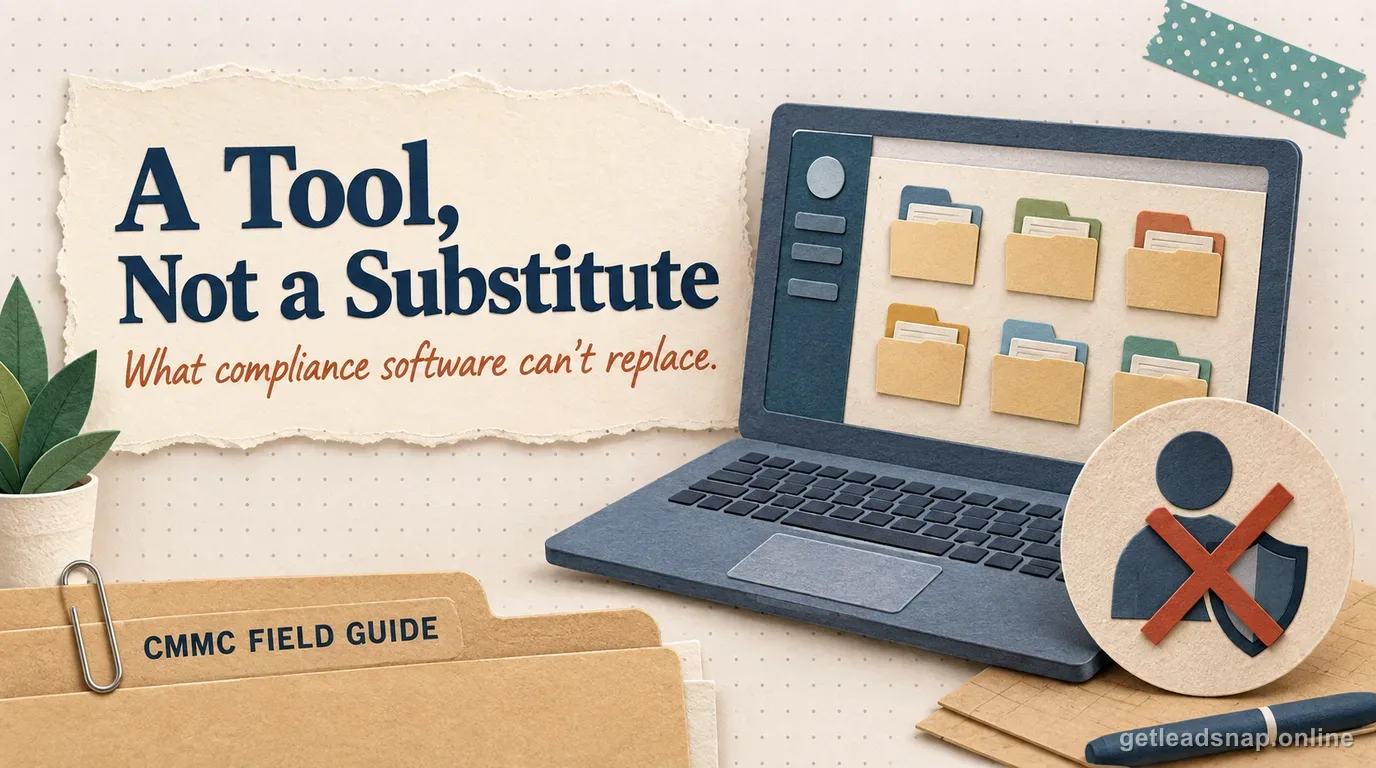
CMMC software is useful when it reduces administrative friction: mapping requirements, assigning owners, storing evidence, tracking findings, and keeping the SSP or control matrix current. It does not make an unimplemented control become implemented.
The working question for a small business under CMMC is concrete: within the defined FCI/CUI boundary, who is responsible for this requirement, and what evidence today shows it is functioning as intended?
The rule in plain English
Assessment procedures can involve examining records, interviewing people, and testing technical operation. A dashboard can organize those artifacts, but it cannot substitute for the endpoint configuration, access process, logging operation, or trained personnel being assessed.
Treat the platform as a system of record for compliance work, not as the source of truth for every technical control.
How to implement it without overbuilding
Choose software based on the actual workflow bottleneck: evidence versioning, control ownership, POA&M management, SSP maintenance, provider inheritance, or reporting.
If the platform stores CUI or sensitive system-security information, evaluate its own security and contractual suitability rather than assuming a 'CMMC tool' label settles that question.
What evidence to keep
Keep platform configuration, control mappings, evidence lineage, owner assignments, review history, and exports that can be understood independently of the vendor.
Critical evidence should not be trapped behind proprietary screenshots.
Where teams get into trouble
A classic failure is auto-generating policies that do not describe the live environment. Another is marking controls complete merely because a document was uploaded.
Small-contractor walkthrough
A compliance platform shows 92% complete because policies were uploaded, yet endpoint configuration and account-review evidence are missing. The readiness team should use the platform to organize work while treating live system records and operating processes as the evidence of implementation.
- Identify the workflow problem first.
- Map tool fields to real evidence.
- Avoid auto-generated fiction.
- Review data stored in the platform.
Decisions to document before assessment
Before marking this topic ready, make four decisions explicit: identify the workflow problem first; map tool fields to real evidence; avoid auto-generated fiction; and review data stored in the platform. Assign an owner and an evidence location to each decision.
Manual deep review
A useful CMMC platform can map requirements and assessment objectives, assign owners, track evidence, version policies, manage findings, maintain an SSP or control matrix, record provider responsibilities, and create an evidence index. Some products also ingest technical status from identity, endpoint, vulnerability, cloud, or ticketing systems. Those capabilities reduce administration when the underlying controls actually operate.
The danger is allowing workflow completion to become a compliance conclusion. Uploading a policy does not prove the technical configuration exists. Marking a control complete does not prove every applicable assessment objective is satisfied. Automatically generated SSP language can be worse than no draft when it describes technologies, owners, or procedures the organization does not really use.
For each evidence type, identify the authoritative source. Directory membership belongs in the identity system, change approval in ITSM, vulnerabilities in the scanner, backup tests in the backup platform, training in the LMS, and approved policies in the controlled repository. The CMMC platform can index or snapshot those records while preserving source, owner, date, objective, and refresh trigger.
Evaluate the platform's own security and scope impact. Uploading CUI, detailed network diagrams, vulnerability results, configuration exports, or sensitive screenshots creates another place where important information is stored. A tool marketed for CMMC is not automatically suitable for every artifact. Minimize sensitive data, keep secrets out, control assessor access, and understand retention, deletion, and export.
During a trial, run real workflows: prove MFA coverage, reconcile assets, close a vulnerability finding, update an SSP statement after architecture changes, and assemble evidence for one requirement. Then test export. The contractor should be able to produce a readable evidence index, open findings, ownership, and core records outside the vendor's green dashboard.
Design evidence refresh and staleness controls
Every imported artifact should have a refresh rule. Directory exports, vulnerability reports, backup results, training records, and policy approvals become stale at different speeds. The platform should record source system, collection time, owner, objective mapping, and the event that requires refresh. A screenshot with no date or source is weak even if it sits in a sophisticated evidence library.
Test what happens when the source changes. If an identity group loses a member, can the platform show that the old export is stale? If a policy is superseded, does the evidence index point to the current approved version? Evidence management should reduce stale proof rather than freeze it.
Keep generated SSP text subordinate to the live environment
If software generates SSP language from questionnaires, require a technical owner to verify every implementation statement before approval. Remove vendor-default text that names tools the contractor does not use or claims controls operate automatically. The SSP should describe real configuration, ownership, and boundaries, even if that means fewer polished paragraphs.
Use change control to update the SSP when the platform detects a material configuration or scope change. Do not allow an AI or template engine to silently rewrite approved compliance statements without owner review.
Prove exitability before adopting the platform
Export the evidence index, control/objective mapping, open findings, SSP content, owners, and supporting metadata during the trial. Confirm the organization can retain a usable record if it changes vendors. Also identify which integrations, API tokens, administrator accounts, and stored data must be removed at termination.
Vendor lock-in is not only a commercial problem. If years of assessment evidence cannot be reconstructed outside one platform, a tool change can become a compliance continuity risk.
Final operating detail
Require the platform to show who changed a control status, evidence mapping, or SSP statement and when. An audit trail helps separate an administrative update from a real change in the environment and prevents unexplained green-status changes before an assessment.
A short working check
- ✓Identify the workflow problem first.
- ✓Map tool fields to real evidence.
- ✓Avoid auto-generated fiction.
- ✓Review data stored in the platform.
- ✓Export evidence periodically.
- ✓Keep technical systems as the source of technical truth.
Common questions
Do we need CMMC compliance software?
No specific platform is mandated. Small contractors can succeed with disciplined document, ticket, and evidence systems.
Can software generate our SSP?
It can help structure the SSP, but the content must accurately describe the real system.
Does a green dashboard mean we pass?
No. Assessment decisions depend on actual requirements and evidence, not a vendor completion percentage.
Should the tool itself be in scope?
If it processes, stores, transmits CUI or protects in-scope components, evaluate its role carefully.
Official sources used for this guide
Open the primary source before making a contract-specific decision. Regulations and program implementation can change.