Microsoft currently states that Microsoft 365 GCC High supports organizations working toward CMMC Level 2 and Level 3 when configured appropriately, while Commercial and GCC offerings have different authorization and data-sovereignty profiles. That does not make GCC High a one-click CMMC certificate.
For most small defense contractors, the requirement is only as real as the evidence behind it — so the useful test is whether it can be traced to a specific system inside the FCI/CUI boundary, an owner, and a current artifact.
The rule in plain English
Meaningful differences include service boundary, U.S. data residency and screened-personnel commitments, DoD impact-level alignment, eligibility, feature availability, and the compliance commitments Microsoft makes for the environment.
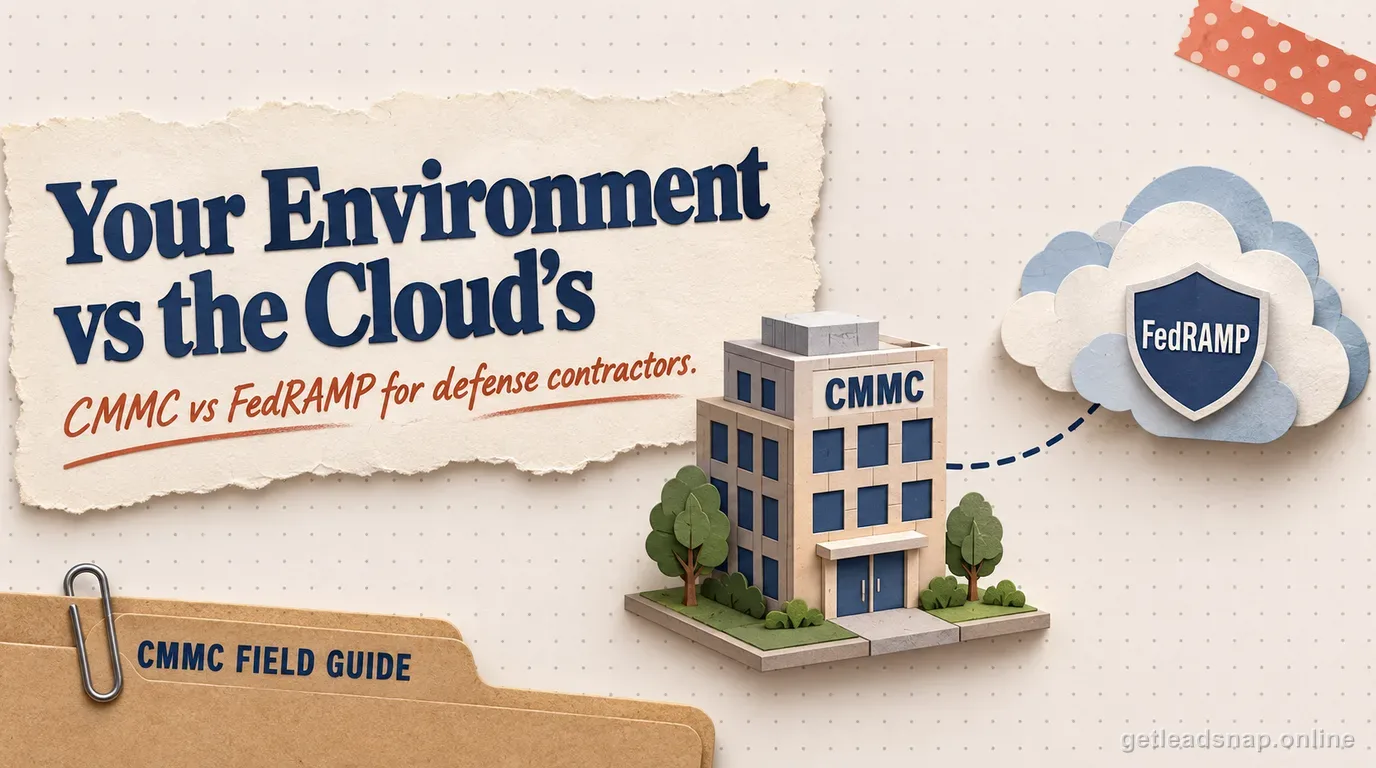
Contractors still own identity, access, data classification, sharing, endpoint, logging, configuration, incident, and operational responsibilities.
How to implement it without overbuilding
Choose the environment based on actual data and contractual requirements, including whether the organization handles CUI Specified or export-controlled information. Review exact Microsoft service descriptions rather than reseller shorthand.
Plan migration for identities, domains, Teams/SharePoint/OneDrive data, third-party apps, mobile devices, and integrations; those can create more scope work than the license purchase.
What evidence to keep
Keep Microsoft service documentation, tenant configuration, licensing/environment identification, data-residency settings, admin roles, sharing controls, audit configuration, and customer-responsibility mapping.
Re-check service feature and compliance pages because cloud boundaries change.
Where teams get into trouble
One myth is 'all CUI requires GCC High' without checking the specific contract/data requirement. The opposite myth is that Commercial Microsoft 365 is always sufficient because the company uses MFA.
What Microsoft says about Commercial, GCC, and GCC High
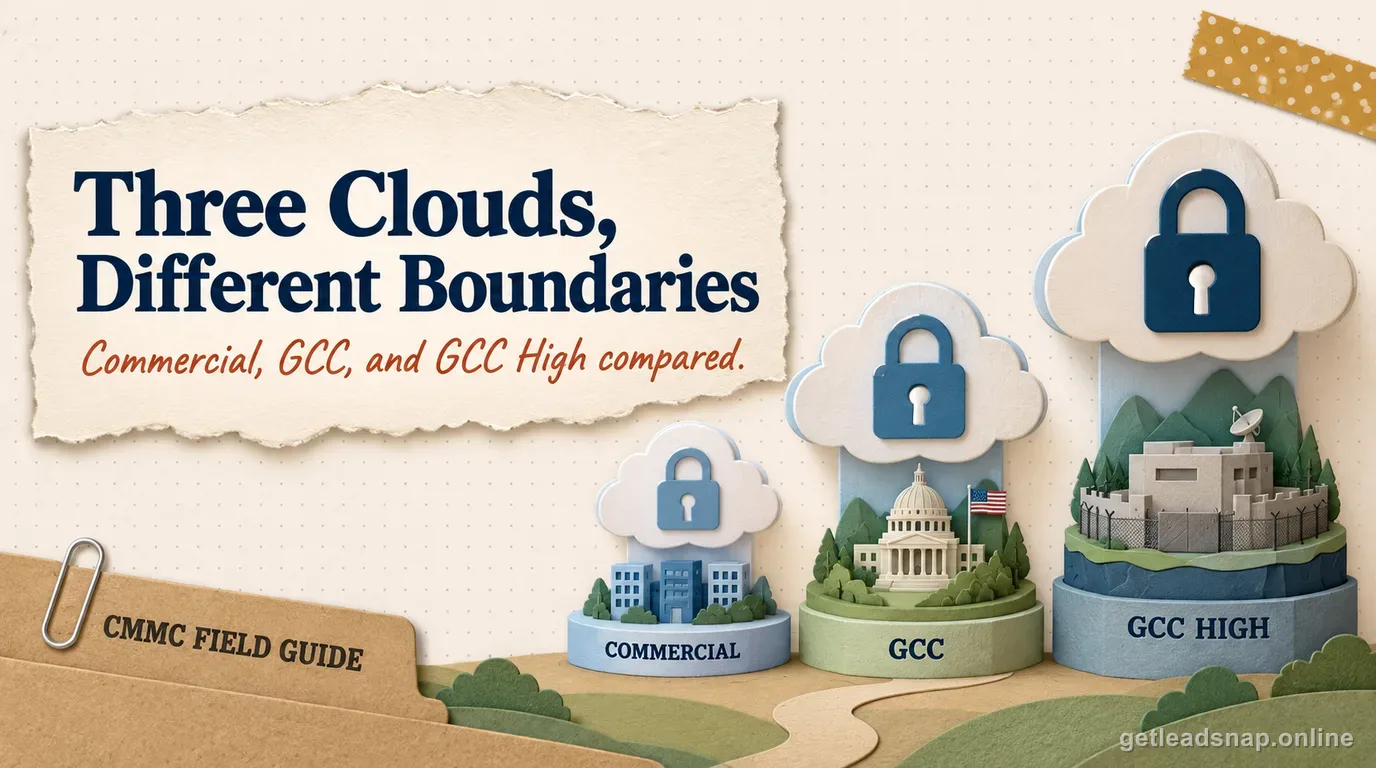
Microsoft's current CMMC page, last updated March 9, 2026, positions Microsoft 365 Commercial as supporting organizations working toward CMMC Level 1 requirements, Microsoft 365 GCC as supporting FedRAMP High, DFARS, and DoD SRG Impact Level 2 commitments, and GCC High as supporting CMMC Level 2 and Level 3 when configured appropriately, along with FedRAMP High, DFARS, IL4, and ITAR-related requirements. That vendor statement should be read together with the contractor's actual DFARS clause and data type.
Microsoft also says GCC is not suitable for CUI Specified such as ITAR- or certain sovereignty-sensitive information and points customers with that data to GCC High. This is more precise than the market shortcut 'all CUI means GCC High.' The choice begins with the exact information and contractual obligations, then the specific Microsoft service boundary and customer configuration.
- Commercial: do not treat normal commercial tenant branding as a CUI authorization.
- GCC: evaluate for the specific CUI and DFARS use case; it has government compliance commitments distinct from Commercial.
- GCC High: designed for higher-sovereignty DoD/CUI use cases and supports Level 2/3 scenarios when configured correctly.
- DoD tenant: a separate environment intended for Department of Defense entities, not ordinary DIB purchase.
The migration decision is mostly about data paths and operations
A GCC High migration is not just a license change. Inventory Exchange mailboxes, SharePoint, OneDrive, Teams, Entra identities, endpoint management, mobile access, backup tools, eDiscovery/retention, third-party apps, line-of-business integrations, and external collaboration. Some features differ between commercial and government clouds, so a workflow that depends on a commercial-only integration can become the most expensive part of the project.
For a narrow CUI population, compare an enclave or split-workload architecture against an organization-wide government-cloud move. The enclave only saves scope if users can reliably keep CUI inside it. Email spillage, browser downloads, sync clients, unmanaged endpoints, and cross-tenant collaboration can defeat a boundary that looks clean on a diagram.
Evidence to capture after choosing the tenant
Record the exact tenant/environment, licensing and eligibility basis, enabled services, data-residency and personnel commitments relied on, privileged roles, conditional-access/MFA configuration, external sharing, audit configuration, retention, endpoint integration, and any services deliberately disabled. Keep the current Microsoft service description because service scope and feature availability can change.
Then map the shared responsibility. Microsoft can provide platform capabilities and inherited controls, but the contractor still has to configure identities, sharing, devices, applications, logs, incident processes, and data handling correctly. A C3PAO or internal reviewer should be able to separate 'Microsoft provides this capability' from 'our organization configured and operates it this way.'
Decision table: when the three Microsoft environments point in different directions
If the organization handles only FCI, Microsoft's Commercial positioning for CMMC Level 1 may be relevant, subject to the contractor's configuration and the actual contract. If the organization handles ordinary CUI, evaluate the DFARS cloud-service requirement and Microsoft's GCC commitments rather than jumping directly from 'CUI' to 'GCC High.' If the data is CUI Specified, ITAR/EAR-related, or the prime/contract requires higher sovereignty, Microsoft's current guidance points toward GCC High.
Do not let licensing labels replace evidence. The assessor-facing record should identify the exact tenant, exact services used for CUI, Microsoft commitments relied on, customer-side controls, and any workloads intentionally left in Commercial. A split environment can be valid only if users and technical controls keep CUI from leaking into the lower-assurance tenant.
- FCI-only workload: verify FAR/CMMC Level 1 requirements and Commercial configuration.
- CUI workload: verify DFARS cloud requirements and exact GCC/GCC High service commitments.
- CUI Specified/export-controlled workload: evaluate sovereignty and GCC High requirements.
- Prime-mandated environment: treat the contractual requirement as a separate decision input.
Re-check the service-level boundary after licensing changes
A tenant decision is not permanent evidence. When Microsoft adds a service, the contractor changes licensing, or a workload moves between Commercial, GCC, and GCC High, update the approved-services list and the CUI data flow. Pay special attention to third-party apps, backups, Power Platform connectors, and AI features that may sit outside the original tenant decision.
Keep the assessor-facing evidence tied to the exact service used, not only the tenant brand.
A short working check
- ✓Classify data first.
- ✓Verify environment commitments.
- ✓Map customer responsibilities.
- ✓Control sharing/apps.
- ✓Plan migration evidence.
- ✓Re-check service scope.
Common questions
Does GCC High automatically make us Level 2 compliant?
No. It provides capabilities and commitments, but the contractor must configure and operate its own controls.
Is GCC the same as GCC High?
No. Microsoft documents different compliance and sovereignty characteristics.
Can Commercial ever support a defense contractor?
Commercial services can be used for workloads that do not require higher government-cloud commitments, subject to actual contract and architecture.
Should third-party Teams apps be reviewed?
Yes. Integrations can introduce new data flows and providers outside the core tenant boundary.
What should be re-checked immediately before using this guide for a contract decision?
Re-open the controlling government source, confirm the solicitation or contract language for the specific information system, and verify that the provider or program status cited here has not changed since September 4, 2026.
Official sources used for this guide
Open the primary source before making a contract-specific decision. Regulations and program implementation can change.