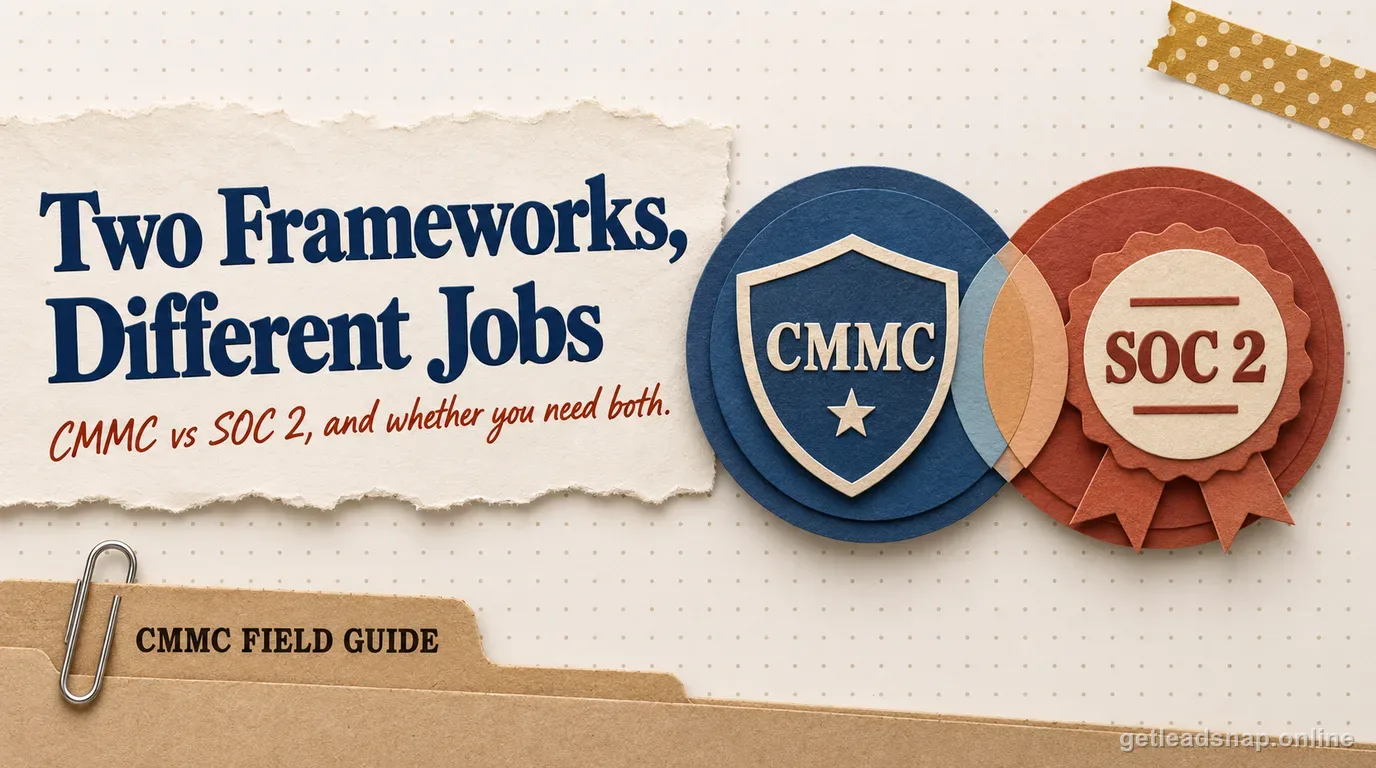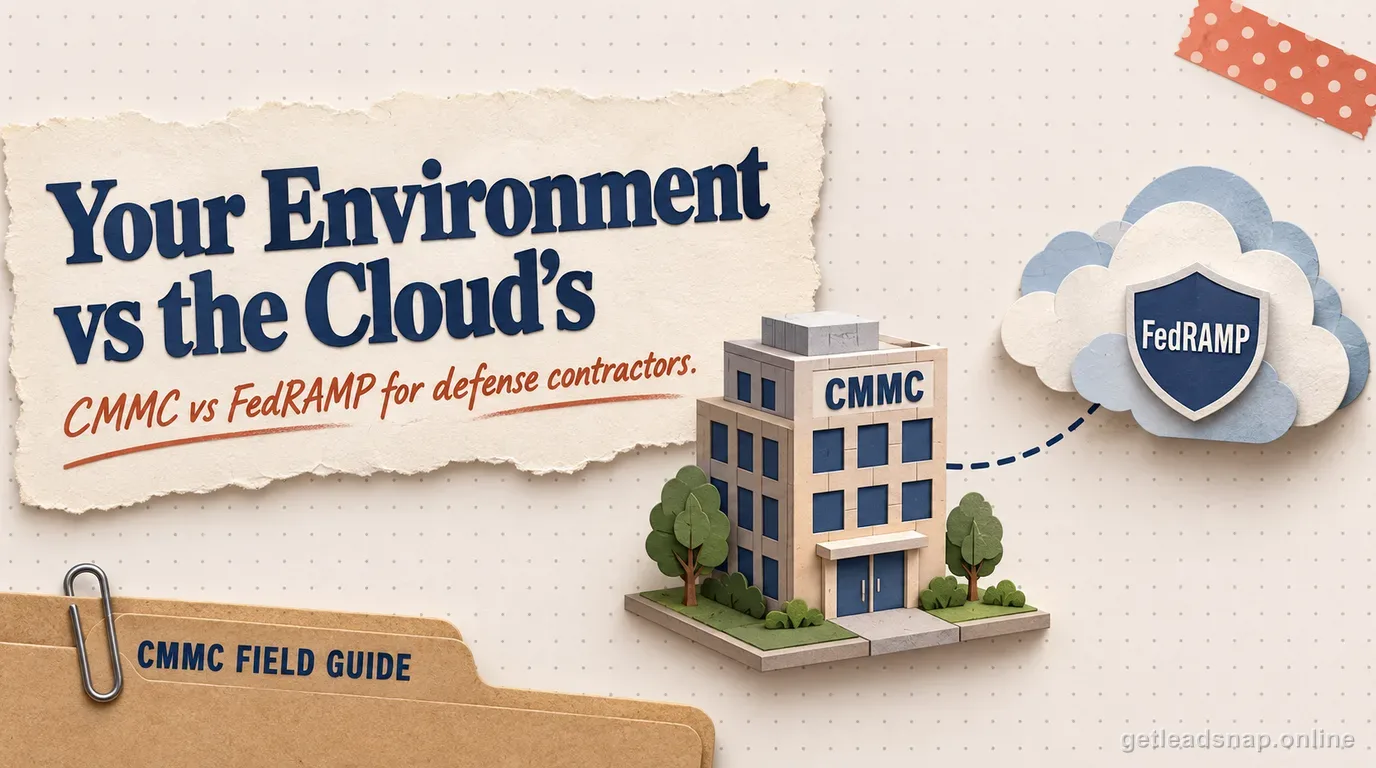
CMMC and FedRAMP address different subjects. CMMC evaluates the contractor's protection of FCI/CUI; FedRAMP is a federal cloud authorization program for cloud service offerings.
For a small defense contractor, the useful test is whether the organization can show how the requirement applies inside the defined FCI/CUI boundary, who operates it, and what current evidence proves it is working.
The rule in plain English
A defense contractor using cloud services to handle covered defense information must pay attention to DFARS cloud requirements and the service's authorization or equivalency posture. That does not mean every contractor must itself become FedRAMP authorized.
Cloud authorization is not a substitute for the contractor's identity, data handling, configuration, monitoring, and incident responsibilities.
How to implement it without overbuilding
For each cloud service, record the exact service/environment, authorization scope, data type, shared-responsibility controls, and configuration required by your architecture.
Verify the exact feature used is in the relevant authorized boundary; product-family branding can be broader than the authorization.
What evidence to keep
Keep authorization evidence, provider responsibility matrix, service configuration, contract terms, and the contractor's own implementation evidence.
Re-check provider scope when new services or AI features are enabled.
Where teams get into trouble
A common error is treating 'FedRAMP' as a company-wide logo. Another is assuming a FedRAMP-authorized service makes every customer configuration compliant.
Small-contractor walkthrough
A contractor uses a FedRAMP-authorized cloud service but has weak customer-side sharing and identity settings. The cloud authorization supports the provider side of the story; it does not remove the contractor's responsibility to configure and operate the service inside the assessed environment.
- Identify cloud services carrying CUI.
- Verify exact authorization scope.
- Review DFARS cloud obligations.
- Map shared responsibilities.
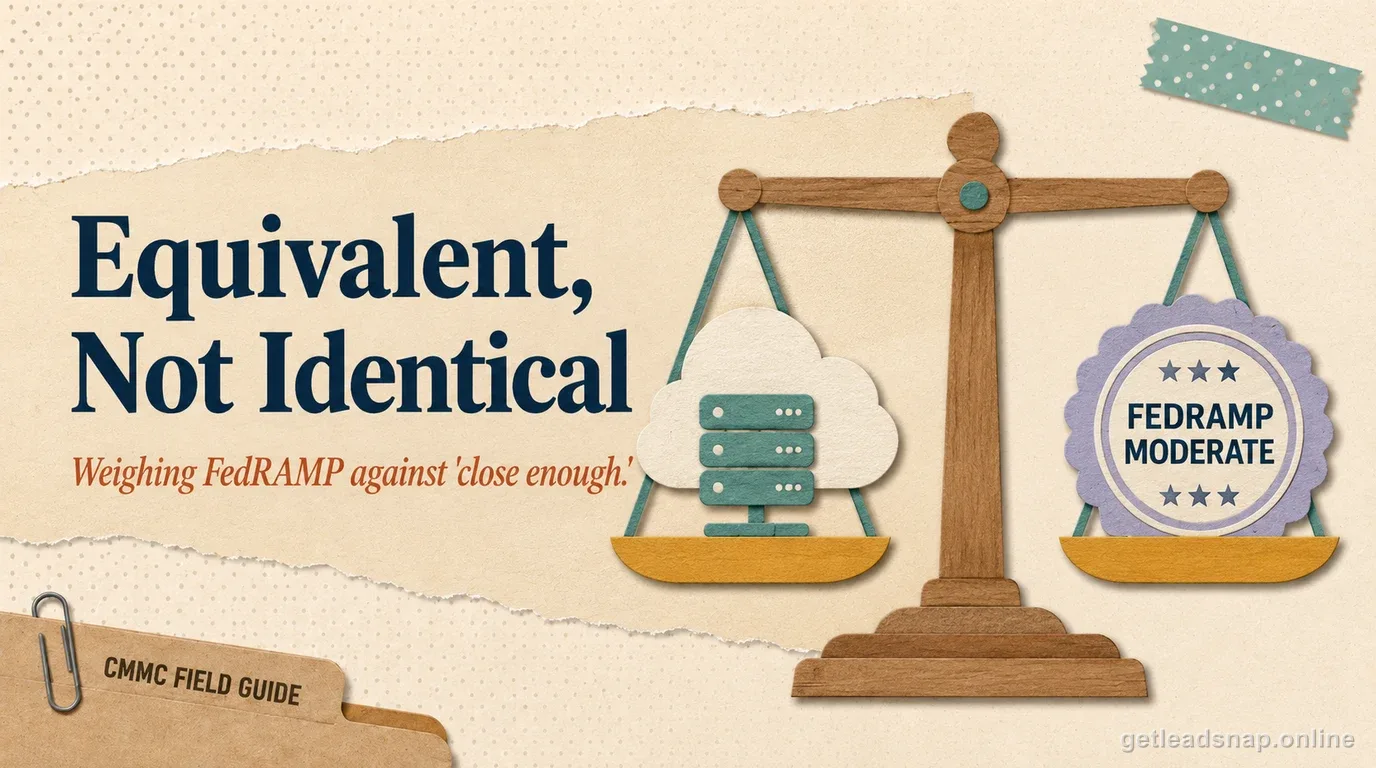
FedRAMP certifies a cloud service offering; CMMC evaluates the contractor system
FedRAMP provides a standardized federal process for certifying cloud service offerings so federal agencies can reuse security evidence when making authorization decisions. CMMC addresses the contractor or subcontractor system used for DoD work. The two programs can touch the same cloud technology, but the object being evaluated is different: FedRAMP focuses on the provider's cloud service offering; CMMC focuses on the contractor's scoped environment and its implementation of the applicable requirements.
For a defense contractor, the direct bridge is DFARS 252.204-7012. When an external cloud service provider stores, processes, or transmits covered defense information for contract performance, the contractor must require and ensure that the provider meets security requirements equivalent to the FedRAMP Moderate baseline and the clause's applicable incident-reporting and preservation obligations. That provider condition does not replace the contractor's own Rev. 2 responsibilities.
A FedRAMP service does not make the tenant configuration CMMC-ready
A cloud provider may supply inherited physical, infrastructure, platform, logging, cryptographic, or operational controls, but the contractor still configures identities, permissions, sharing, endpoints, applications, data flows, integrations, retention, and incident processes. The provider's certification package describes the service offering; the contractor's SSP and evidence must describe how the organization actually uses that service inside the CMMC boundary.
Verify the exact cloud service offering and boundary. A product-family brand can include add-ons, regions, integrations, AI functions, or services outside the package the contractor relies on. Record the provider/service name, current FedRAMP or equivalency evidence, customer responsibility documentation, enabled services, and CUI data path. Recheck after material service changes instead of treating one old authorization screenshot as permanent proof.
When a company may genuinely need both programs
A normal defense contractor that merely consumes cloud usually does not pursue FedRAMP certification for its entire company. It evaluates whether the cloud service used for covered defense information meets the DFARS requirement while the contractor maintains the applicable CMMC posture. A company that also sells its own cloud service offering to federal agencies may separately pursue FedRAMP for that offering and CMMC for the contractor system used in DoD performance.
Keep the boundaries explicit. A FedRAMP-certified offering may support CMMC through inherited capabilities, but it does not certify the contractor's laptops, users, local networks, providers, or customer-side configuration. Likewise, CMMC status for a contractor system does not place the company's SaaS product in the FedRAMP Marketplace or authorize a federal agency to use it.
- Cloud service offering: verify FedRAMP/DFARS evidence.
- Contractor CUI system: maintain CMMC/Rev. 2 evidence.
- Customer configuration: document separately from inherited controls.
- Company that is also a CSP: treat each program as a separate scope.
Last-mile depth check
One additional review is to compare the provider's current FedRAMP Marketplace/service information with the contractor's actual tenant configuration and contract clause. This catches a common gap where the provider is correctly authorized but the contractor is using a feature, region, integration, or data path that was never evaluated in the assumed cloud boundary.
A short working check
- ✓Identify cloud services carrying CUI.
- ✓Verify exact authorization scope.
- ✓Review DFARS cloud obligations.
- ✓Map shared responsibilities.
- ✓Control new features.
- ✓Retain provider evidence.
Common questions
Do all CMMC contractors need FedRAMP authorization?
No. A contractor may consume a suitably authorized cloud service without becoming a FedRAMP cloud provider.
Is FedRAMP Moderate always enough for CUI?
The actual contract and DFARS cloud requirements control. Verify the specific service and requirement.
Does a FedRAMP service automatically satisfy CMMC?
No. Customer implementation and operational controls remain.
Why do service lists matter?
Authorization applies to defined services and boundaries; adjacent features may have different status.
Does FedRAMP Moderate make our whole company CMMC compliant?
No. It supports the cloud-provider side of the DFARS cloud requirement; the contractor still owns its CMMC boundary, configuration, users, endpoints, processes, and evidence.
Official sources used for this guide
Open the primary source before making a contract-specific decision. Regulations and program implementation can change.