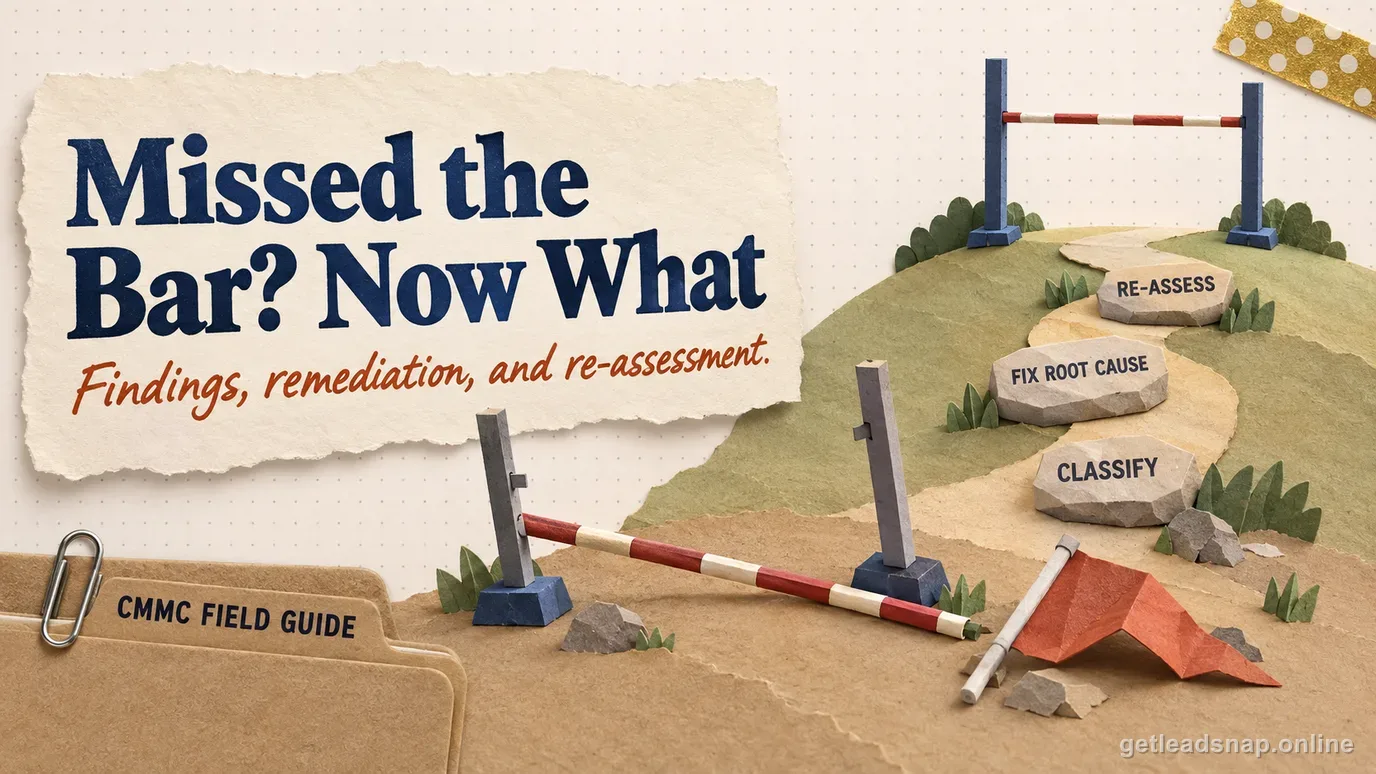
A failed CMMC assessment is not solved by rewriting the SSP. The organization must understand which assessment objectives were not met, what technical or process condition caused the finding, and whether the program permits that item to be addressed through conditional-status POA&M rules.
A small defense contractor gets more value from asking a narrower question: where inside the FCI/CUI boundary does this requirement apply, who owns it day to day, and what evidence currently backs it up?
The rule in plain English
Some deficiencies cannot be deferred for conditional status. If the minimum conditions are not met, the organization may need to remediate and undergo a new assessment rather than relying on a closeout path.
Commercial effects such as proposal eligibility, customer confidence, rescheduling cost, or contract timing depend on the specific requirement and assessment circumstances.
How to implement it without overbuilding
For each finding, document root cause, affected assets, remediation design, owner, test, evidence, and any resulting change to the SSP or procedure.
Do not optimize only for an assessor's wording. Fix the underlying security outcome so the evidence remains defensible after the immediate assessment event.
What evidence to keep
Keep the finding record, remediation ticket, configuration change, test result, updated documentation, internal validation, and formal closeout or reassessment records.
Preserve before-and-after evidence when it helps show exactly what changed.
Where teams get into trouble
Teams sometimes argue about terminology while leaving the technical gap unresolved. Another mistake is assuming a compensating control or policy statement automatically replaces an unmet Rev. 2 requirement.
First determine which assessment outcome you actually have
CMMC does not reduce every imperfect assessment to one generic 'fail.' Under the rule, a requirement is MET only when all applicable objectives are satisfied with final-form evidence. For Level 2, the scoring methodology starts from 110 and deducts weighted values for requirements that are NOT MET. Conditional status is available only when the rule's score and POA&M eligibility conditions are satisfied; otherwise the organization has not achieved the required status and must remediate before the appropriate reassessment path.
For a Level 2 certification assessment, 32 CFR 170.17 also permits a narrow re-evaluation window: a NOT MET requirement may be re-evaluated during the active assessment and for 10 business days afterward when additional evidence exists, it does not undermine other MET requirements, and the Assessment Findings Report has not yet been delivered. This is an evidence window, not permission to redesign the environment after the assessment.
Conditional status is a clock, not a relaxed passing grade
Where a valid POA&M is permitted, the Level 2 certification closeout must be performed within 180 days of the Conditional CMMC Status Date. Not every missing requirement can be placed on that plan, and Level 1 permits no POA&M at all. The remediation team should therefore classify the finding against the rule before promising management that it can be fixed later.
Build the remediation record around root cause. If the finding was missing evidence but the control was actually operating, preserve the evidence lineage and assessment facts. If the control was technically absent or misconfigured, fix the system, update documentation, test the result, and collect operating evidence. Do not turn a technical deficiency into a paperwork project.
- Finding and affected assessment objective.
- POA&M eligibility and score effect.
- Root cause and affected assets/users.
- Remediation change, test result, and updated SSP/procedure.
Protect the contracting record while remediation is underway
Use formal status language in customer and internal communications. Conditional status is not the same as Final status, and 'almost certified' is not a program term. If the organization does not hold the status a solicitation or contract requires, contracts leadership should know before anyone makes a representation to a prime or contracting officer.
After remediation, follow the correct closeout or reassessment path and verify that the official status record reflects the result. Preserve the before-and-after evidence because the next annual affirmation requires the organization to stand behind continuing implementation, not merely the fact that a finding was once closed.
Use the finding report to decide whether the problem is evidence, implementation, or scope
An evidence problem means the organization believes the control is operating but could not prove an applicable objective with acceptable final-form evidence. An implementation problem means the required outcome is absent or ineffective. A scope problem means the assessment discovered CUI, assets, users, or protection systems outside the declared boundary. These three causes need different recovery plans even if all appear as NOT MET findings.
For evidence issues inside a Level 2 certification assessment, the 10-business-day re-evaluation rule may matter when additional evidence already exists and the formal conditions are met. For implementation or scope failures, assume the organization must actually change the environment and validate the change; do not try to manufacture retrospective evidence for a control that was not operating.
- Evidence gap: locate legitimate existing final-form proof and verify re-evaluation eligibility.
- Implementation gap: remediate the control, test it, and update documentation.
- Scope gap: redraw the boundary, inventory newly discovered assets, and reassess dependent controls.
- Governance gap: correct owner, approval, or escalation process before the next assessment.
Preserve the original failure record while proving remediation
When a NOT MET item is remediated, do not replace the original evidence or finding with a cleaner retrospective story. Keep the assessment finding, remediation ticket, implementation change, post-change validation, updated SSP/process, and closeout evidence as a sequence.
This timeline helps distinguish a legitimate closeout from an attempt to make it appear that the control was operating before the assessment.
Before assessment week
- ✓Classify each finding.
- ✓Check POA&M eligibility.
- ✓Fix the root cause.
- ✓Update the SSP or procedure.
- ✓Test remediation.
- ✓Schedule the proper closeout or reassessment.
Common questions
Can we fix findings during the assessment?
Assessment procedures and timing rules control what can be considered. Do not assume last-minute changes will erase a finding.
Is there always a 180-day remediation period?
No. Conditional status has a 180-day closeout concept for eligible cases, but not every failed assessment or requirement qualifies.
Can a new screenshot prove remediation?
It can be part of the evidence, but the organization should show that the control is correctly implemented and operating.
Will we need a full reassessment?
Possibly, depending on whether the result qualifies for conditional status and the program's closeout rules.
What should be re-checked immediately before using this guide for a contract decision?
Re-open the controlling government source, confirm the solicitation or contract language for the specific information system, and verify that the provider or program status cited here has not changed since September 4, 2026.
Official sources used for this guide
Open the primary source before making a contract-specific decision. Regulations and program implementation can change.