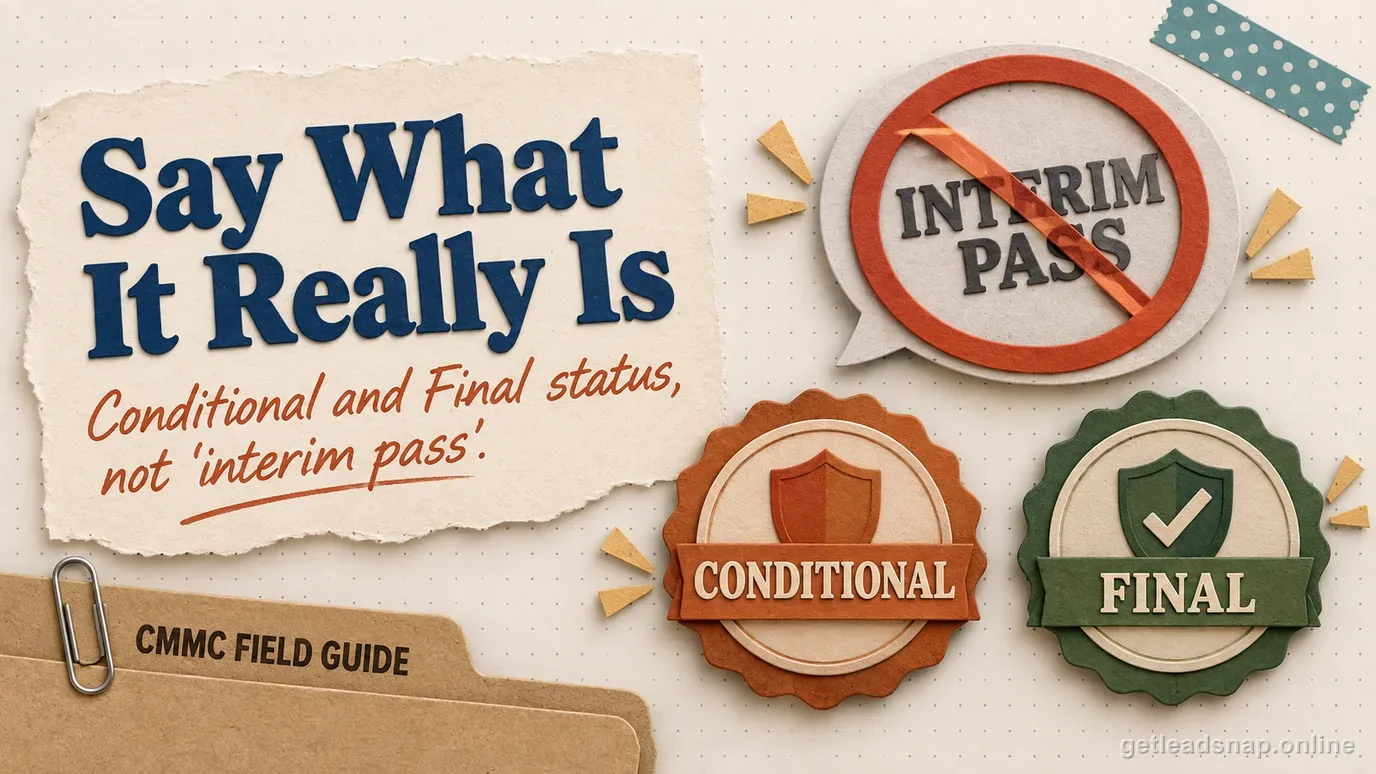
Be careful with the phrase 'interim assessment result.' The CMMC program uses formal concepts such as Conditional CMMC Status and Final CMMC Status, with specific rules for permitted POA&M items, closeout, affirmation, and validity.
The working question for a small business under CMMC is concrete: within the defined FCI/CUI boundary, who is responsible for this requirement, and what evidence today shows it is functioning as intended?
The rule in plain English
A conditional status is not the same as a final status. The organization must close eligible POA&M items within the allowed period and complete the required closeout assessment to reach final status.
The exact contracting consequence depends on the level and status required by the solicitation or contract and the current DFARS rules.
How to implement it without overbuilding
After any non-final outcome, create a controlled finding register tied to the assessment result. Separate items eligible for POA&M from items that must have been met at the initial assessment.
Assign owners, evidence, target dates, and a closeout method. Anchor the interpretation to the actual 32 CFR rule rather than to an advisor's shorthand.
What evidence to keep
Keep the official assessment result, permitted score/details, POA&M, closeout evidence, affirmation, SPRS status, and correspondence about corrections.
Document the date from which any conditional-status closeout window runs.
Where teams get into trouble
A frequent mistake is telling customers 'we passed' while the organization holds only conditional status. Another is assuming every unmet requirement can go on the POA&M.
Small-contractor walkthrough
Management calls a conditional result an 'interim pass.' The compliance lead uses the formal CMMC status terms instead, separates POA&M-eligible items from non-deferrable requirements, and tracks the allowed closeout window and evidence needed to reach final status.
Assessment mechanics are easier when the organization uses formal program terms and preserves a clear chain from objective to evidence to result. Informal labels such as 'pass-ish' or 'interim certified' create avoidable confusion.
Treat every finding, status change, closeout action, and affirmation as a governed record with dates, owners, supporting evidence, and the exact system or scope to which it applies.
- Use formal status terminology.
- Identify POA&M-eligible findings.
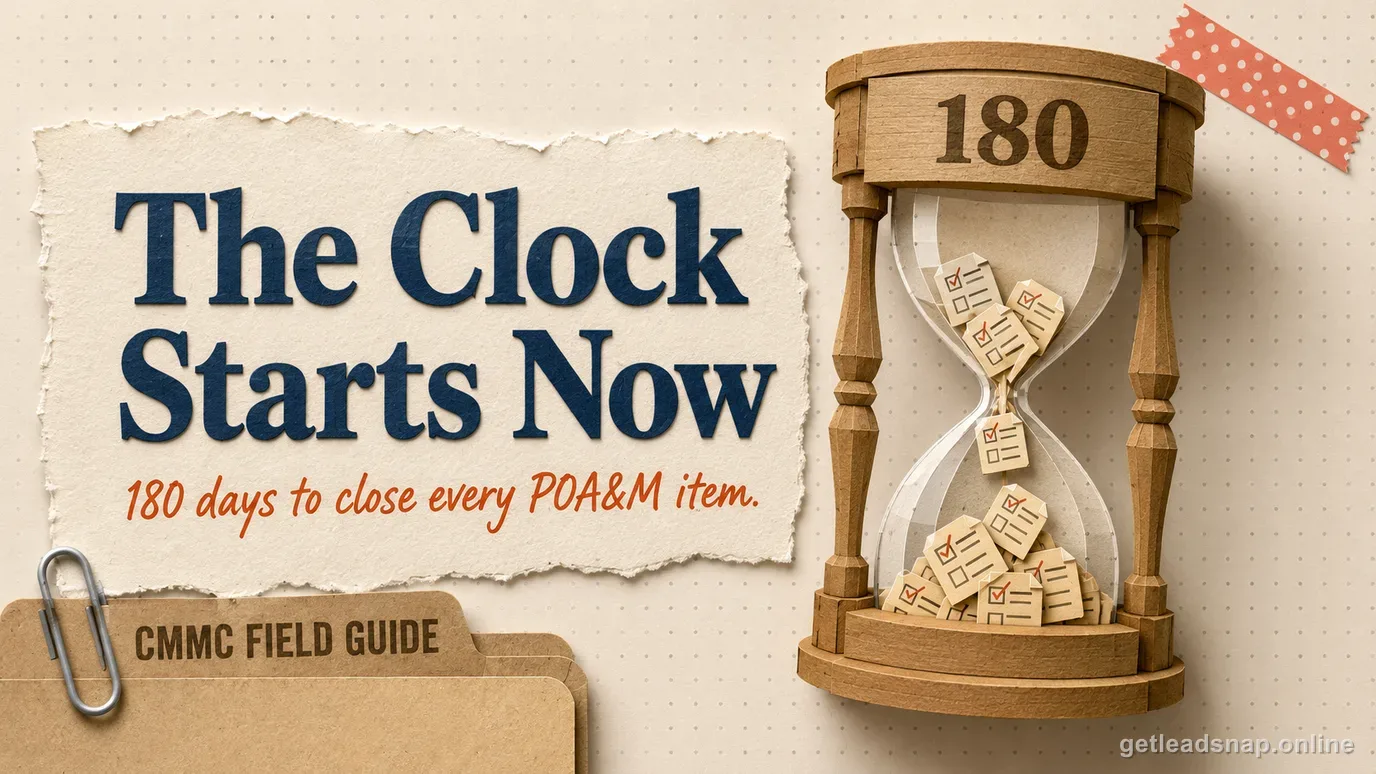
- Track the applicable 180-day closeout window.
- Retain closure evidence.
'Interim result' is informal; the rule uses Conditional and Final
The formal Level 2 certification rule recognizes Conditional Level 2 (C3PAO) and Final Level 2 (C3PAO), not a generic 'interim certification.' Conditional status exists only when the assessment result and permitted POA&M satisfy the rule. It is not a general grace period for unfinished controls.
Final status can be achieved during the initial assessment or after a valid POA&M closeout assessment. A Conditional Level 2 status expires if the permitted POA&M is not successfully closed within 180 days of the Conditional status date, with the contract and award consequences described by the rule.
The 10-business-day re-evaluation window is evidence-only
A NOT MET requirement may be re-evaluated during the assessment and for 10 business days after the active assessment period only when additional evidence is available, the re-evaluation does not undermine other MET requirements, and the findings report has not been delivered. This is not time to implement a control that was missing during assessment.
Separate three cases: overlooked existing evidence, a real NOT MET that is POA&M-eligible, and a NOT MET that cannot be carried on a permitted POA&M. Each needs a different response. Calling all three 'interim findings' hides important deadlines and eligibility rules.
Post-assessment actions by status
If status is Conditional, build the 180-day closeout plan around owners, technical dependencies, validation evidence, and C3PAO scheduling. If status is Final, record the status date, annual affirmation owner, three-year assessment horizon, and monitoring needed to maintain continuous compliance.
Reconcile the final findings report to the SSP, evidence index, and remediation records. Preserve historical assessment artifacts; do not rewrite old evidence after remediation to make it look as if the control was always implemented.
- Identify formal Conditional or Final status.
- Separate re-evaluation from remediation.
- Validate POA&M eligibility.
- Track 180-day closeout when Conditional.
- Assign annual affirmation ownership.
Last-mile topic check
For every Conditional status item, record the exact 180-day deadline and closeout evidence owner rather than using a generic 'remediation in progress' status in management reporting.
Do not merge the three clocks into one remediation window
The 10-business-day re-evaluation window, the 180-day Conditional-status POA&M closeout window, and the three-year certification cycle solve different problems. Re-evaluation is for qualifying existing evidence before the findings report is delivered; the 180-day window is for permitted POA&M remediation and closeout; the three-year cycle is the recurring certification horizon for the applicable Final or Conditional status framework. Put all three dates on the assessment calendar so management does not mistake one clock for another.
Communicate status using the formal label and the controlling date
Management reports should say Conditional Level 2 (C3PAO) or Final Level 2 (C3PAO), include the CMMC Status Date, and list the next action. Avoid 'passed with exceptions' or 'interim certified' because those phrases hide the formal 180-day closeout and affirmation requirements.
Put re-evaluation deadlines, POA&M closeout deadlines, and annual affirmation on separate calendar entries so the organization never treats them as one generic remediation period.
Before assessment week
- ✓Use formal status terminology.
- ✓Identify POA&M-eligible findings.
- ✓Track the applicable 180-day closeout window.
- ✓Retain closure evidence.
- ✓Complete required affirmation.
- ✓Verify SPRS status.
Common questions
Is conditional status a full final certification?
No. It is a distinct program status with closeout conditions.
Can every failed requirement go on a POA&M?
No. CMMC limits which unmet requirements can be deferred for conditional status.
What happens after closeout?
The applicable closeout assessment verifies eligible findings so the organization can reach final status if the requirements are met.
Should customer communications say 'interim pass'?
Use the formal status instead of shorthand that may overstate the result.
Is Conditional status an interim certificate?
No. Conditional is the formal rule term with specific POA&M eligibility and a 180-day closeout requirement.
Official sources used for this guide
Open the primary source before making a contract-specific decision. Regulations and program implementation can change.