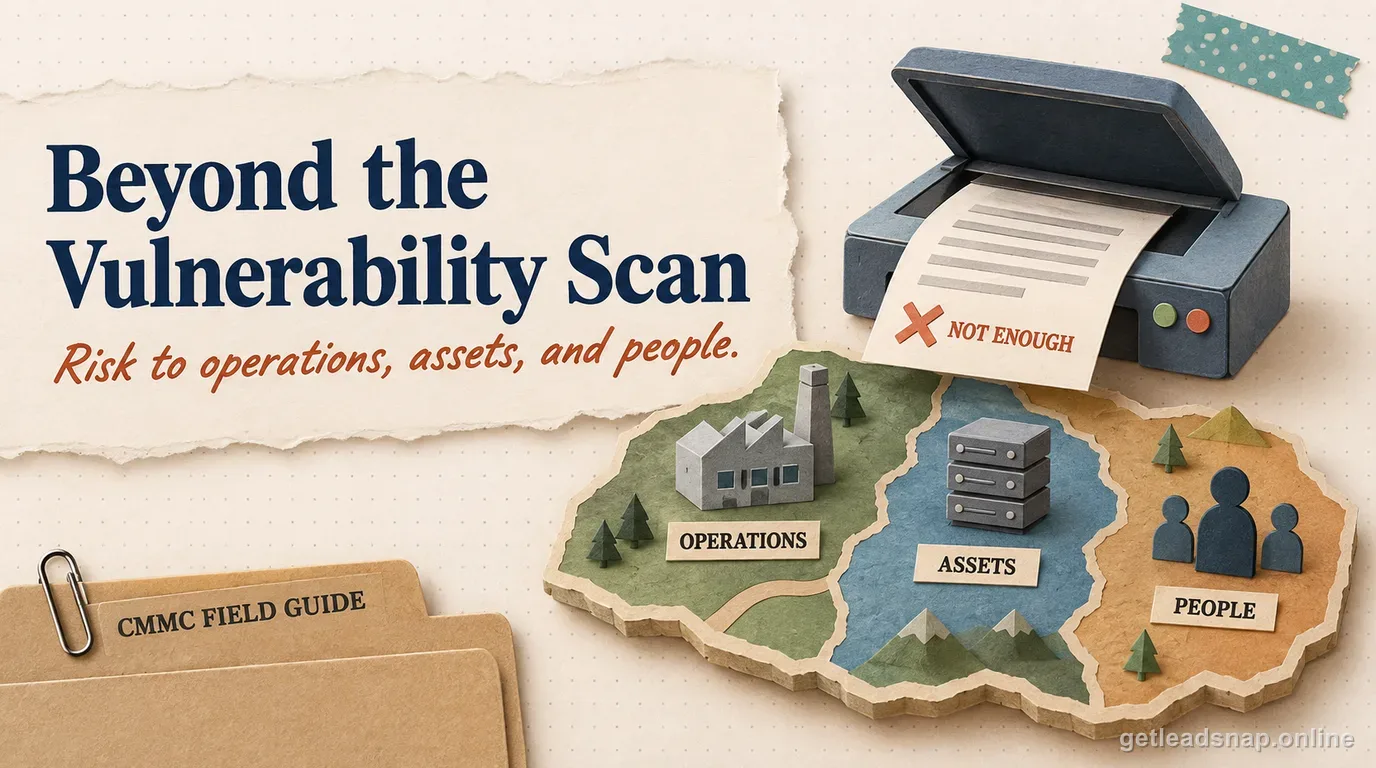
Requirement 3.11.1 and vulnerability scanning are not the same thing. A scan finds technical weaknesses; the risk assessment considers threats, likelihood, impact, organizational context, and the effect on operations, assets, and individuals.
A small defense contractor gets more value from asking a narrower question: where inside the FCI/CUI boundary does this requirement apply, who owns it day to day, and what evidence currently backs it up?
The rule in plain English
A useful risk assessment connects threats, vulnerabilities, business context, existing safeguards, and consequences. It can draw on scan results, incidents, architecture changes, supplier issues, and new technology.
The requirement is periodic. Material changes can justify an out-of-cycle review even when the company also has a regular schedule.
How to implement it without overbuilding
Use a lightweight risk register if it is actively maintained. Score only to the level that improves decisions; elaborate mathematics with no action does not strengthen the control.
Include CUI-specific scenarios such as credential compromise, ransomware, data exfiltration, cloud misconfiguration, remote-access abuse, or loss of a device or backup.
What evidence to keep
Keep the risk methodology, dated assessment, risk register, approvals, mitigation decisions, accepted-risk rationale, and follow-up records.
Strong evidence shows identified risks influencing priorities instead of disappearing into a spreadsheet.
Where teams get into trouble
The classic gap is calling a vulnerability scan the risk assessment. Another is documenting risks with no owner, treatment decision, or follow-up.
Small-contractor walkthrough
A quarterly vulnerability scan shows several medium findings while a recent phishing incident exposes a credential-reuse weakness. The risk assessment should combine technical findings with business impact and threat context rather than treating the scanner's severity label as the final risk decision.
The fastest way to find a weak implementation is to pick a recent real event and replay it from beginning to end.
Control-family work is easiest to defend when the organization starts with the actual users, systems, and workflows in the CUI boundary, then ties policy language to settings and operating records.
If the team has to reconstruct approvals from memory or cannot reconcile the record to the current asset and identity inventories, the process needs operational work before more documentation is added.
Technical tooling can support the control, but the assessor still needs to see the organization's decisions, ownership, and evidence. Keep exceptions explicit and narrow.
- Define assessment cadence.
- Use scan and incident inputs.
- Identify CUI-specific scenarios.
- Assign risk owners.
Decisions to document before assessment
Before marking this topic ready, make four decisions explicit: define assessment cadence; use scan and incident inputs; identify cui-specific scenarios; and assign risk owners. Assign an owner and an evidence location to each decision.
If one of those decisions depends on a provider, prime, subcontractor, assessor, or other external party, record the dependency and the evidence you expect from that party. That prevents a control from appearing complete internally while the proof actually sits outside the organization with no retrieval path.
Readiness test
Pick one real user, asset, workflow, contract, or evidence item and trace it from the governing requirement to the documented process and then to live evidence. If the trail breaks, fix the operating process before adding more narrative.
Keep the conclusion narrow. CMMC evidence is strongest when it says exactly what is in scope, exactly how the requirement is met, and exactly which record proves the claim.
Manual deep review
3.11.1 is broader than a vulnerability scan. Build risk scenarios around what can actually happen to the CUI environment: credential compromise reaching cloud data, ransomware on an engineering workstation, vendor remote access abuse, a sharing misconfiguration exposing drawings, failed backup recovery, or a legacy shop-floor system creating a pivot path. Vulnerability findings, incidents, provider changes, threat information, and architecture changes are inputs; they are not the whole risk assessment.
Use a simple, consistent decision model: scenario, affected assets/business process, likelihood, impact, existing safeguards, residual exposure, owner, and treatment. Define what ratings mean so different reviewers do not score the same condition arbitrarily. IT can provide technical facts while a business owner decides whether downtime, contract delay, or controlled-data exposure is acceptable.
Make “periodic” operational by defining a normal review cadence plus event triggers such as a cloud migration, acquisition, new site, material CUI-flow change, significant incident, new service provider, or architecture redesign. Do not invent a universal annual interval for 3.11.1 when the organization has chosen and documented another defensible cadence.
For assessment, trace one current risk from source evidence through evaluation, owner, treatment, and action record. Then trace one closed risk and prove the mitigation actually reduced the exposure. A closed ticket alone is not enough if the residual-risk decision never changed.
Cross-check the risk register against the SSP, asset inventory, CUI data flows, provider list, incidents, and latest vulnerability findings. A material system or dependency missing from every risk discussion should trigger investigation rather than being accepted as proof that no risk exists.
Final article-specific QA 1
Cross-check the risk register against current assets, CUI flows, vulnerability findings, incidents, and providers; investigate any material dependency absent from risk discussion. This check applies specifically to CMMC Risk Assessment Requirements Beyond the Vulnerability Scan (3.11.1) and should be recorded with the article's evidence notes.
Re-open the current primary sources used by cmmc-risk-assessment-requirement-3-11-1 (nist-r2, nist-171a, cmmc-l2-assessment-guide-2-13) before publication or a contracting decision. Verify every regulatory 'must' against the source and keep implementation examples clearly labeled as examples.
For CMMC Risk Assessment Requirements Beyond the Vulnerability Scan (3.11.1), retain one normal operating example and one edge case. The normal example proves routine operation; the edge case proves that ownership, escalation, evidence, and scope remain accurate when the standard workflow changes.
A short working check
- ✓Define assessment cadence.
- ✓Use scan and incident inputs.
- ✓Identify CUI-specific scenarios.
- ✓Assign risk owners.
- ✓Record treatment/acceptance.
- ✓Revisit after material changes.
Common questions
Can our vulnerability scan be the risk assessment?
It can be an input, but by itself it usually does not address likelihood, impact, operations, assets, and individuals.
Does NIST require a specific risk formula?
No single scoring formula is mandated by 3.11.1.
Who should own risks?
Assign business or technical owners who can make or escalate treatment decisions.
Should a cloud migration trigger review?
A material architecture or data-flow change is a strong reason to revisit relevant risks.
Official sources used for this guide
Open the primary source before making a contract-specific decision. Regulations and program implementation can change.