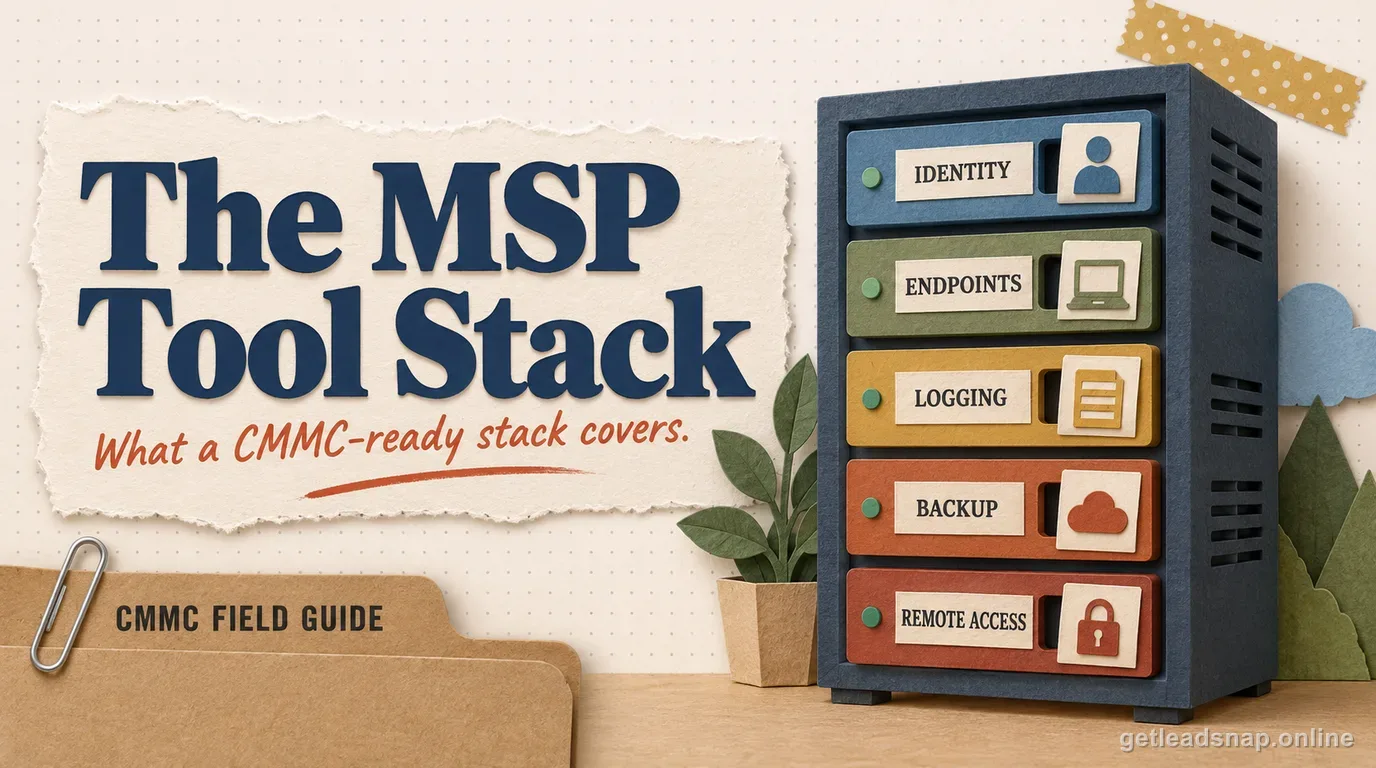
There is no official 'CMMC-certified tool stack.' MSPs should build around required security outcomes and evidence: identity and MFA, endpoint configuration and protection, logging/monitoring, vulnerability management, patching, backups, secure remote access, encryption, ticket/change records, and controlled administration.
For most small defense contractors, the requirement is only as real as the evidence behind it — so the useful test is whether it can be traced to a specific system inside the FCI/CUI boundary, an owner, and a current artifact.
The rule in plain English
Each tool should be evaluated for where its data lives, who can access it, how it is secured, what evidence it produces, and whether it expands the client's boundary.
A smaller, well-integrated stack can be easier to assess than a large stack of overlapping products with unclear ownership.
How to implement it without overbuilding
Map capabilities to Rev. 2 requirements and assessment objectives. For every tool, name the outcomes it supports and the customer responsibilities it does not satisfy.
Standardize exports and evidence-retention procedures so client assessments do not depend on ad hoc screenshots.
What evidence to keep
Keep architecture, service inventory, configuration baselines, client-specific reports, admin logs, patch/vulnerability records, backup test records, and evidence mapping.
Review new integrations before enabling them for CUI clients.
Where teams get into trouble
Common failures are marketing-driven tool selection, duplicate agents, uncontrolled SaaS integrations, and security products that send sensitive data into systems never evaluated for the CUI environment.
Small-contractor walkthrough
An MSP standardizes identity, endpoint protection, logging, vulnerability management, patching, backup, secure remote access, and ticketing. The useful question for each product is which control outcome it supports, what data it handles, and what customer responsibility remains.
- Map tools to control outcomes.
- Document customer responsibilities.
- Minimize overlap.
- Review data locations.
Start with required outcomes, then select tools
A 'CMMC-ready stack' is not an official product bundle. NIST SP 800-171 Rev. 2 states security requirements; the contractor and MSP select technologies and processes that meet them in the actual environment. Build a capability map before a shopping list: identity and MFA, privileged access, endpoint configuration, vulnerability management, patching, malicious-code protection, logging, remote access, backup/recovery, incident response, and evidence generation.
For each capability, identify the tool, owner, systems covered, data collected, administrator path, evidence export, dependencies, and customer responsibilities. One platform may support several requirements; one requirement may need several technologies plus policy and human action. Avoid vendor marketing that turns 'supports 40 controls' into 'implements 40 controls.'
Every management and security tool has a scope footprint
RMM, EDR, SIEM, backup, identity, vulnerability, documentation, remote support, password vault, ticketing, and cloud-management systems can process CUI or Security Protection Data depending on configuration. Before standardizing a tool for defense clients, inspect tenant separation, data location, admin roles, logs, API integrations, vendor support access, retention, incident handling, and whether the platform acts as a CSP or other ESP.
Prefer evidence-friendly integrations. The stack should let the MSP export client-specific device coverage, policy status, privileged roles, vulnerability findings, patch status, backup tests, alerts, and changes without exposing other customers. Evidence generation is not the reason to buy a security control, but inability to prove client-specific operation is a real assessment problem.
A smaller coherent stack can outperform a larger overlapping stack
Duplicate agents and dashboards create inconsistent inventories, alert ownership, configuration drift, and provider dependencies. Standardize where that improves security and evidence, but keep documented exceptions for specialized assets or contractual constraints. Record why each major component exists and which requirement outcomes it supports.
Run a quarterly managed-stack review for defense clients: reconcile tool coverage to the scoped asset inventory, review integrations, confirm admin accounts, inspect provider or subprocessor changes, validate backups and alert routing, and test evidence export. A stack becomes CMMC-useful only when the MSP can demonstrate coverage and the client performs responsibilities technology cannot replace.
Use a decommissioning rule too. When a new platform replaces an old tool, remove stale agents, API keys, admin accounts, log destinations, and data retention unless a documented business or evidence need remains. Old management paths can silently expand attack surface and assessment scope.
Last-mile depth check
For each major platform, keep a one-page service card naming the security outcome supported, client data handled, provider role, administrator path, evidence export, failure mode, and replacement/decommissioning process. This makes the stack maintainable when vendors change and prevents years of undocumented tool accumulation.
Operational edge-case check
Add a replacement-readiness check for every core platform. Record how client configuration, evidence, logs, and historical records can be exported if the MSP changes vendors. A tool that secures the environment well but traps all control history in a proprietary console can create assessment and transition risk later.
A short working check
- ✓Map tools to control outcomes.
- ✓Document customer responsibilities.
- ✓Minimize overlap.
- ✓Review data locations.
- ✓Standardize evidence exports.
- ✓Control integrations.
Common questions
Is there a list of CMMC-approved products?
CMMC does not provide a universal product list that automatically makes an environment compliant.
Does every tool need FedRAMP?
Not every tool is a cloud service handling covered defense information. Evaluate its actual role and contractual requirements.
What makes a stack assessor-friendly?
Clear scope, stable configuration, strong identity separation, consistent logs, and exportable evidence tied to requirements.
Should MSPs standardize one stack?
Standardization helps operations, but customer data types and contract requirements can still require exceptions.
Is there an official CMMC-approved tool stack?
No. Tools support requirements and evidence; the contractor still has to implement and prove the security outcomes in its scoped environment.
Official sources used for this guide
Open the primary source before making a contract-specific decision. Regulations and program implementation can change.